 From
January 19-21, 2005, FAS Agricultural Counselor Bob Hoff,
Agricultural Specialist Ken Joseph, and Marketing Specialist
Maria Julia Balbi, stationed in Embassy Buenos Aires, carried
out a field visit, covering close to seven hundred miles
(over one thousand kilometers), in major agricultural and
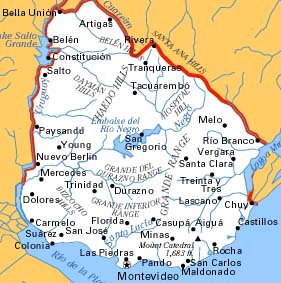
livestock producing areas in northeast and southwest Uruguay.
Their first stop was at the National Agricultural and Livestock
Research Institute (INIA) experimental station in Tacuarembo,
followed by a visit to the Carrau Winery in Cerro Chapeu,
department of Rivera. FAS Buenos Aires personnel ended their
field visit at the INIA experimental station in La Estanzuela,
located in the department of Colonia.
INIA’s experimental station in Tacuarembo,
one of five located throughout Uruguay, focuses its research
on livestock, pastures, and forestry, which are of critical
importance to the regional economy. INIA officials noted,
though, that soybean plantings have increased exponentially
over the last few years. For the 2005 crop season, however,
drought-like conditions have prevailed, and the outlook
for the soybean crop in the department of Tacuarembo did
not look promising. Forestation projects have also increased
in number, stimulated by incentives provided by the Uruguayan
Government. These forestation projects typically are located
in areas of the department characterized by sandy soils.
Carrau
Wineries, which is headquartered in Montevideo, opened a
winery in Cerro Chapeu, department of Rivera, on the border
with Brazil, in 1998. This winery is endowed with some of
the most modern technology available, and has a design,
which optimizes space, and maximizes quality. Close to 60
percent of the wine is aged in barrels made of U.S. oak.
The winery is surrounded by vineyards, which grow, in the
main, Tannat, Chardonay, and Cabernet Sauvignon grapes.
The sandy soils facilitate drainage. When this winery reaches
full capacity, according to Director Javier Carrau, it will
export 80 percent of its production. Principal export markets
are the U.S., Canada, the European Union, and Brazil.
The INIA experimental station in La
Estanzuela, Colonia, was founded in 1914. As with the INIA
experimental station in Tacuarembo, its personnel are highly
trained, a number with advanced degrees from U.S. universities.
INIA focuses its mission on research in row crops such as
soybeans and wheat, and provides consulting services, for
a fee, to area growers. It also has an office, which tracks
changes in Uruguay’s climate. It has had a scientific
exchange agreement with USDA since 2000, and works closely
with the Universidad de la Republica, in Uruguay, and the
University of Minnesota.
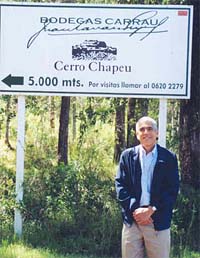
Agricultural Counselor Bob Hoff
in Rivera |
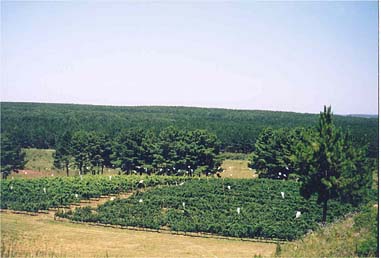
Carrau Wineries vineyards at Cerro Chapeu in Rivera |
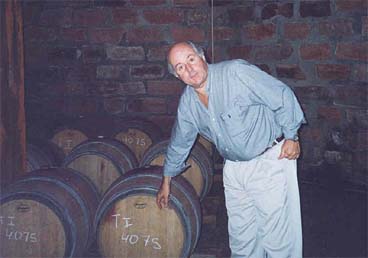
Javier Carrau, Director of Carrau Wineries |
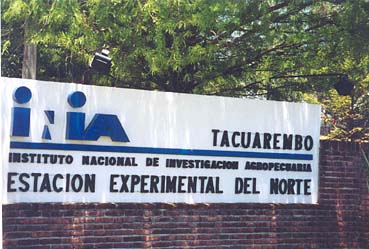
The
INIA experimental station in Tacuarembo |
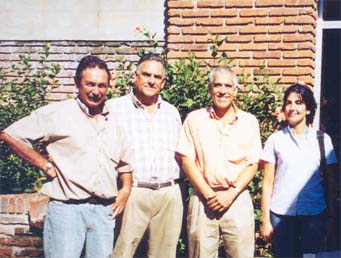
Andres Lavecchia, Diego Risso,
Bob Hoff, and M. Julia Balbi at
the INIA station in Tacuarembo |
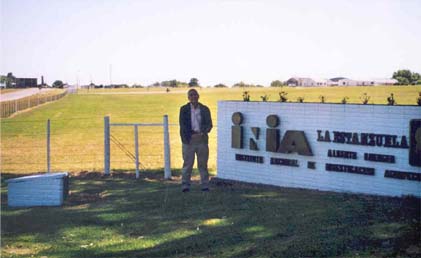
Agricultural Counselor Bob Hoff
at the INIA experimental station in La Estanzuela, Colonia |
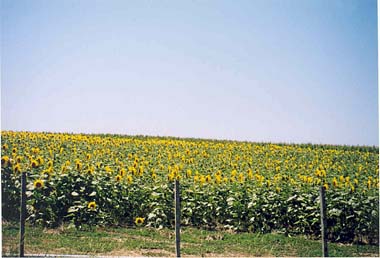
Sunflower field at the La Estanzuela
INIA station |


