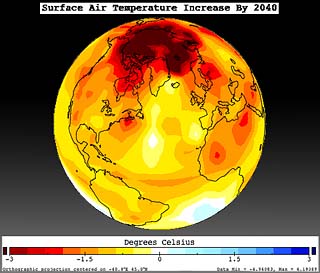
College and secondary
school students can now use a version of NASA's global climate
computer model (GCM) to see how Earth's climate is changing.
According to a January 10 NASA press release,
a GCM calculates many things, such as how much sunlight
is reflected and absorbed by Earth's atmosphere; the temperature
of the air and oceans; the distribution of clouds, rainfall,
and snow; and the future of the polar ice caps.
Scientists run the GCM on supercomputers
to simulate climate changes of the past and future, and
an educational version for use on personal computers (PCs)
is now available to educators and students at universities
and high schools.
The Educational Global Climate Model (EdGCM),
available for Microsoft Windows and Macintosh platforms,
was unveiled January 10 at the annual meeting of the American
Meteorological Society in California.
EdGCM incorporates a three-dimensional climate
computer model that includes complex computer programs in
a way that will be familiar to most PC users. Though the
climate model runs on a desktop computer, it still allows
teachers and students to conduct experiments identical to
those that scientists are running on the more powerful supercomputers.
EdGCM also links the climate model to a
database and scientific visualization tools, making it simpler
to create and organize data and images.
An "EdGCM Cooperative" is also
being designed to encourage communication between students
at different schools and between schools and research institutions.
This cooperative will help students become familiar with
the role that teamwork plays in scientific research today.
Additional information on this subject is
available http://www.nasa.gov/vision/earth/everydaylife/climate_class.html
Specific information about the project is
available at http://www.edgcm.org/
EdGCM software may be downloaded at http://www.edgcm.org/EdGCMCooperative/Downloads.php
Text of the NASA press release follows:
(begin text)
NASA
Press release, January 10, 2005
[Washington, D.C.]
Watching Earth's Climate Change in the Classroom
College and high school students can now
see how Earth's climate is changing without leaving their
computers.
NASA and other organizations use NASA's
global climate computer model (GCM) to see how Earth's climate
is changing. A GCM calculates many things, such as how much
sunlight is reflected and absorbed by Earth's atmosphere,
the temperature of the air and oceans, the distribution
of clouds, rainfall, and snow, and what may happen to the
polar ice caps in the future.
Scientists run the GCM on supercomputers
to simulate climate changes of the past and future, and
an educational version is now be available to educators
and students at universities and high schools, where desktop
PCs are the norm.
The Educational Global Climate Model (EdGCM),
available for both Windows and Mac platforms, was unveiled
at the Annual meeting of the American Meteorological Society,
at the San Diego Convention Center, San Diego, Calif. on
Monday, January 10, 2005.
EdGCM incorporates a 3-D climate computer
model developed at NASA's Goddard Institute for Space Studies,
New York, includes complex computer programs in a way that
will be familiar to most PC users. Though the climate model
runs on a desktop computer, it still allows teachers and
students to conduct experiments identical to those that
scientists are running. Additionally, EdGCM links the climate
model to both a database and scientific visualization tools,
making it simpler to create and organize data and images.
"The real goal of EdGCM is to allow
teachers and students to learn more about climate science
by participating in the full scientific process, including
experiment design, running model simulations, analyzing
data, and reporting on results via the world wide web,"
said Mark Chandler, lead researcher for the EdGCM project
from Columbia University in New York City.
An "EdGCM Cooperative" is also
being designed to encourage communication between students
at different schools and between schools and research institutions.
This cooperative will help students become familiar with
the role that teamwork plays in scientific research today.
Educational materials associated with the
EdGCM project are also under development. A curriculum module
on carbon dioxide (CO2) and global warming will walk students
through a complete scientific project involving GCMs and
analyzing a changing climate. Students will also be able
to re-create ancient climates from the times of the dinosaurs
or the water cycles of future climates.
Professors at three N.Y. area universities
are already using EdGCM. Professors and students at Columbia
University, City University of New York, and New York University,
can now conduct research projects using the NASA/GISS GCM.
At least two high schools in Madison, Wis. are also testing
EdGCM this semester in Earth Science courses, and several
other schools may begin using the software next year.
"EdGCM is not just for looking at climate
on the Earth," Chandler said. We're keeping an eye
on being able to use it to eventually simulate the atmospheres
of other planets, too."
(end text)