 |
"We will
not resort to violence. We will not degrade ourselves with
hatred.
Love will not be returned with hate."
Martin Luther King, Jr.
 HEAR THE "I HAVE A DREAM" SPEECH |
PRESIDENT BUSH'S REMARKS (01/17/2005)
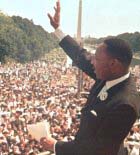
< The Reverend Martin Luther King Jr. acknowledges the crowd from the
steps
of the Lincoln Memorial during his "I Have a Dream" speech.
(8/28/1963) |
It was December, 1955, and Martin Luther King, Jr. had just
received his doctorate degree in theology. He had moved
to Montgomery, Alabama to preach at a Baptist church. He
saw there, as in many other southern states, that African-Americans
had to ride in the back of public buses. Dr. King knew that
this law violated the rights of every African-American.
He organized and led a boycott of the public buses in the
city of Montgomery. Any person, black or white, who was
against segregation refused to use public transportation.
Those people who boycotted were threatened or attacked by
other people, or even arrested or jailed by the police.
After one year of boycotting the bus system, the Supreme
Court declared that the Alabama state segregation law was
unconstitutional.
African-Americans were not only segregated
on buses throughout the south. Equal housing was denied
to them, and seating in many hotels and restaurants was
refused.
In 1957, Dr. King founded the Southern Christian
Leadership Conference and moved back to his home town of
Atlanta, Georgia. This was the beginning of the Civil Rights
Movement. In the years following, he continued to organize
non-violent protests against unequal treatment of African-American
people. His philosophy remained peaceful, and he constantly
reminded his followers that their fight would be victorious
if they did not resort to bloodshed. Nonetheless, he and
his demonstrators were often threatened and attacked. Demonstrations
which began peacefully often ended up in violence, and he
and many others were often arrested.
On August 28, 1963, a crowd of more than
250,000 people gathered in Washington, D.C. and marched
to the Capitol Building to support the passing of laws that
guaranteed every American equal civil rights. Martin Luther
King was at the front of the "March on Washington."
On the steps of the Lincoln Memorial that day, Dr. King
delivered a speech that was later entitled "I Have
a Dream." The March was one of the largest gatherings
of black and white people that the nation's capital had
ever seen... and no violence occurred.
One year later, the Civil Rights Act of
1964 was passed. It was not the first law of civil rights
for Americans, but it was the most thorough and effective.
The act guaranteed equal rights in housing, public facilities,
voting, and public schools. Everyone would have impartial
hearings and jury trials. A civil rights commission would
ensure that these laws were enforced. Martin Luther King
and thousands of others now knew that they had not struggled
in vain.
In 1968, Martin Luther King, Jr. was assassinated
while he was leading a workers' strike in Memphis, Tennessee.
White people and black people who had worked so hard for
peace and civil rights were shocked and angry. The world
grieved the loss of this man of peace.
The Making of a Holiday
Martin Luther King's death did not slow the Civil Rights
Movement. Black and white people continued to fight for
freedom and equality. Coretta Scott King is the widow of
the civil rights leader. In 1970, she established the Martin
Luther King Jr. Memorial Center in Atlanta, Georgia. This
"living memorial" consists of his boyhood home
and the Ebenezer Baptist Church, where King is buried.
On Monday, January 20, 1986, in cities and
towns across the country people celebrated the first official
Martin Luther King Day, the only federal holiday commemorating
an African-American. A ceremony which took place at an old
railroad depot in Atlanta Georgia was especially emotional.
Hundreds had gathered to sing and to march. Many were the
same people who, in 1965, had marched for fifty miles between
two cities in the state of Alabama to protest segregation
and descrimination of black Americans.
All through the 1980's, controversy surrounded
the idea of a Martin Luther King Day. Congressmen and citizens
had petitioned the President to make January 15, Martin
Luther King's birthday, a federal legal holiday. Others
wanted to make the holiday on the day he died, while some
people did not want to have any holiday at all.
January 15 had been observed as a legal
holiday for many years in 27 states and Washington, D.C.
Finally, in 1986, President Ronald Reagan declared the third
Monday in January a federal legal holiday commemorating
Dr. Martin Luther King's birthday.
Schools, offices and federal agencies are
closed for the holiday. On Monday there are quiet memorial
services as well as elaborate ceremonies in honor of Dr.
King. On the preceding Sunday, ministers of all religions
give special sermons reminding everyone of Dr. King's lifelong
work for peace. All weekend, popular radio stations play
songs and speeches that tell the history of the Civil Rights
Movement. Television channels broadcast special programs
with filmed highlights of Dr. King's life and times.
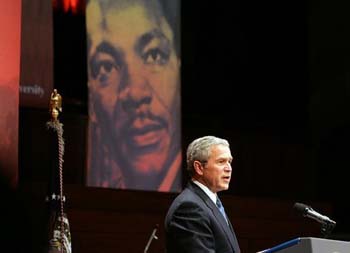 'LET
FREEDOM RING' EVENT: PRESIDENT BUSH'S REMARKS
01-17-2005 4:16 P.M. EST  AUDIO
THE PRESIDENT: Thank you all. Thanks for
coming. Thanks for the invitation. Laura and I are pleased
to join you on this national holiday as we honor two exceptional
Americans who we're proud to call friends.
I want to thank Dr. DeGioia and Georgetown
University for sponsoring the John Thompson Legacy of a
Dream Award. I want to thank the Georgetown Gospel Choir
for sharing their gifts at this celebration. I want to thank
John Thompson for being here and for setting such a great
example. I appreciate the thoughtful words from one of the
most recognized voices in America, Tom Joyner. (Applause.)
I can't wait to hear Aaron Neville. (Applause.) I want to
thank the members of Congress, the members of my administration
and all the distinguished guests who are here today. I also
want to thank Dr. Dorothy Height for joining us this afternoon.
(Applause.)
Every year on this day we reflect the history
of civil rights in America. It's a story of our founders,
among them, slave owners, who declared a standard of equality
and justice that would one day be used to put an end to
slavery. It's a story of a terrible war that freed men and
women from bondage, but not from oppression and segregation.
It's a story of generations "not having received the
promises, but having seen them afar off." And it's
a story of Americans like Reverend Dr. Martin Luther King,
Jr., who held our nation to those promises and would not
rest until they were written into law. (Applause.)
Dr. King was a minister of the gospel who
could have had an easy life in a respected pulpit. Today,
he would be just 76 years old. Instead, he chose to minister
in the spirit of John Wesley, who said, "I look upon
all the world as my parish." The nation first took
notice in the 1950s and in the 1960s, when he wrote, "I
am in Birmingham because injustice is here." In the
space of just a few years, through the power of his intellect,
the truth of his words, and the example of his courage,
he left this country a different and better place, and made
his own journey to a different and better place. (Applause.)
Dr. King believed so fully in the ideals
of America that he was offended every day that they were
violated. He had studied the founding documents and found
no exceptions to the promise of freedom. He was disappointed
in the unfair practices of his country. Yet he said, "There
can be no deep disappointment where there is not deep love."
Dr. King loved America enough to confront its injustices,
not compromising the truth and not fearing any man -- and
America loves him in return. (Applause.)
Martin Luther King also knew that man's
right to be free is rooted in something far beyond the charters
of a country. He believed and he knew that the image of
God we share is a source of our dignity as human beings
and the basis for our equality. He believed and he knew
that the teachings of Jesus stand in eternal judgment of
oppression. He believed and he knew that the God who made
us for freedom will bring us to freedom. (Applause.)
By observing and honoring Dr. King's birthday,
we teach the next generation lessons that must never be
forgotten. We need our children to know how great the struggle
for racial justice in our society has been, and how much
work remains to be done. (Applause.) We need them to know
that the greatest causes sometime involve the greatest sacrifices,
and that history moves forward on the strength of those
sacrifices. And we need the children of America to know
that a single life of conscience and purpose can touch and
lift up many lives. The influence of one good life is also
the message of the Legacy of a Dream Award -- in this case
the influence of two good lives.
Alma and Colin Powell are among the most
admired people in our country. (Applause.) For these four
years, they've also been America's representatives to the
world. They are honorable people who bring honor to this
nation, and America is grateful for their example of service.
As their friends know, Alma and Colin met
on a blind date. (Laughter.) Alma has said she remembers
the future general looking like a lost 12-year-old. (Laughter
and applause.) And that's the side of the man I've never
seen before. (Laughter.) For his part, Colin has said that
night he was "mesmerized by a pair of luminous eyes,
an unusual shade of green." And from that day to this,
he has been fortunate to have this beautiful, accomplished
woman at his side. (Applause.)
Colin Powell has lived his own inspiring
story, a story of exceptional accomplishment that started
before segregation ended. When he was a young officer, someone
told him, "You are the best black lieutenant I have
ever known." He later wrote, "Inside me, I was
thinking, if you intend to measure me only against black
lieutenants, you are making a mistake." (Laughter and
applause.) "I'm going to show you" -- he went
on to write, "I'm going to show you the best lieutenant
in the Army, period." (Applause.)
The best lieutenant in the Army went on
to a distinguished military career that ended with four
stars on his shoulder. (Applause.) Along the way, he earned
two Purple Hearts, the Bronze Star, the Soldier's Medal,
the Legion of Merit, the Congressional Gold Medal and two
Presidential Medals of Freedom. (Applause.) I'm not through
yet. (Laughter.) I'm just getting started. (Laughter.) See,
he's been an official in the administration of six Presidents,
including service as the National Security Advisor to President
Reagan, the Chairman of the Joint Chiefs of Staff under
Presidents Bush and Clinton.
More than four years ago, when I needed
a Secretary of State, I knew what I was looking for. I wanted
someone who believed deeply in the values of our country,
and could share them with the world; a person of wisdom
and decency; a leader who could bring out the best in people.
I found all this and more in Colin Powell. (Applause.) Our
65th Secretary of State became one of the most effective
and admired diplomats in America's history. He has helped
to rally the world in a global war and to resolve dangerous
regional conflicts and to confront the desperate challenges
of natural disaster and hunger and poverty and disease.
He's been tireless and selfless and principled. In the work
he and I have shared, he has become a great friend, and
I appreciate all he has done for our wonderful country.
(Applause.)
His proudest achievements probably have
little to do with public service. See, he's a wonderful
dad to Michael and Annemarie and Linda. Over the years,
he's been a mentor to young people. As a founder of America's
Promise, Colin has drawn countless others to become involved
in the lives of children, and to give them the hope and
confidence they need for a successful life. Today, we honor
not just Colin Powell's lifetime of leadership, but we honor
his great kindness and his compassion. (Applause.)
The same kinds of idealism and character
have marked the life of Alma Johnson Powell. Like her husband,
she was raised by strong and decent people. And Birmingham,
where Martin Luther King was jailed -- Birmingham, which
-- where he was jailed, was also the home of the Johnson
family. That's where she was raised in other words. (Laughter.)
Alma remembers her father during the worst of days sitting
up at night with a shotgun by his side to protect his wife
and his children. Mr. Johnson was a high school principal,
and he was a legend to generations of students who remember
his high standards and his imposing presence. His daughter,
Alma, has always been impressive, as well, because of her
grace and her principle.
For many years, Alma served America as a
soldier's wife, moving the household 18 times, and leading
the family when the Army -- (Applause.) Anyone who wants
to know the meaning of duty and unselfish love can look
at our military families like the Powells. (Applause.) This
good-hearted mother and grandmother shares her love with
others as the Chair of America's Promise. People here at
the Kennedy Center know her as the leading member of the
board of trustees. She's a noted author of several children's
books, and a volunteer who gives her time to help young
people make good choices in life. Alma Powell is one of
the finest people Laura and I are privileged to know. And
she is a superb choice for the Legacy of a Dream Award.
(Applause.) I'm not kidding, either. (Applause.)
You have chosen, on this important day for
America, to pay tribute to a woman and a man who have upheld
the highest ideal of American citizenship. In their love
of country, and their heart for service, they show the same
character found in the life of Dr. Martin Luther King. Thank
you for the privilege of joining you this afternoon, and
for the pleasure of being able to honor these fine, fine
Americans.
May God bless the Powells, and may God continue
to bless the United States of America. (Applause.)
END 4:30 P.M. EST


