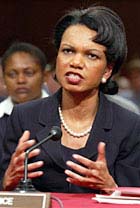
 Questioned
by Senator Christopher J. Dodd on U.S. policies in Latin
America, Secretary of State-designate Condoleezza Rice stated,
on day one of her confirmation hearings, that the Bush Administration
is "trying to work relationships, key relationships,
in this region in a very aggressive way".
SEN. DODD:
(...) I want to thank my colleagues for raising some of
the issues they have. Obviously, Iraq is a major current
foreign policy question and rightfully would dominate our
conversation here today. As Senator Chafee mentioned, Senator
Chafee and Senator Nelson and I just completed an eight-day
trip to Latin America, visiting Venezuela, Paraguay, Argentina,
Peru and Ecuador coming back. And I want to focus some attention
on that in this first round. There are other questions I
have.
There are roughly 600 million people in
this hemisphere, excluding ourselves, who look to the United
States for leadership. Two of our most important trading
partners, Mexico and Canada, of course, in this hemisphere.
The issues that Senator Sarbanes has raised about economic
policy are absolutely on target and ones that we should
be paying much more attention to, in my view, because as
we found over the last eight days traveling in South America,
these issues are the ones they care the most about, in many
ways, and they're the ones the absence of our attention
to these questions over the last number of years, for reasons
they understand -- certainly 9/11 diverted our attention
elsewhere, the events in the Middle East have certainly
dominated our attention, but I want you to know at least
my observations over the last week or so is we're in trouble
in his hemisphere, Dr. Rice. We're in deep trouble in this
hemisphere. And others may know other parts of the world
well, and certainly there have been great changes in China,
India, Russia, the Middle East, certainly in Africa, but
we need to get back on track in this hemisphere.
And I'm going to ask you a broader question
about what direction we're going to take. Let me tell you
just briefly some of the things that we found over the last
seven or eight days. And my colleagues, Senator Nelson,
Senator Chafee, can add or detract from these conclusions.
We found these governments facing major
demands from their citizens, with inadequate resources to
meet those demands. In fact, the budget indications coming
out of the administration are significantly -- going to
provide significantly less resources in terms of aid to
this part of the world than has been the case in previous
years.
You mentioned the important years of 1947,
'48, '49 and thereafter in terms of our efforts to grapple
with the great challenge of the second half of the 20th
century. Certainly one of the great speeches given that
set the tone for that was Harry Truman's only inaugural
address, in which point four, which set up the U.S. aid
missions that made a huge difference in the 1950s and '60s,
the Alliance for Progress that Senator Kennedy initiated,
these ideas had strong economic components to them as we
grappled with the great challenges facing choices in those
days between what the Soviet Union offered and what we offered.
So we found great demands on the part of
the citizens of these countries. We found government institutions
that have been weakened and co-opted by unsolved internal
political disputes. We found government officials interested
in concluding bilateral free trade agreements not only because
it would improve access to our markets but because they
know it can be a means of institutionalizing reforms that
would mean more jobs and incomes to their citizens.
We found government leaders concerned about
the decline in U.S. resources available to assist them in
the fight against narcoterrorists, terrorists ready to take
advantage of the lawlessness created by the systemic corruption
that exists generally throughout the region and especially
in the tri-border area of Paraguay and Brazil and Argentina,
where Muslim organizations are reportedly raising and laundering
monies to support their international ambitions.
We found government leaders frustrated by
the suspension of U.S. military assistance and training
to their military services because of our fixation with
the International Criminal Court, as codified by the American
Servicemen's Protection Act, which links continued assistance
to these areas to the signing of the so-called Article 98
agreements of the United States. And I heard this from American
military personnel, Dr. Rice, not from foreigners, but our
own personnel worried that we're placing so much emphasis
on that point we're stopping the training so necessary to
build those relationships in this century with people in
that part of the world.
We found government leaders desirous of
positive relationships with the United States and disappointed
that our government hasn't made relations with them a higher
national priority. Even President Chavez expressed an interest
in improved relations with the United States. Putting aside
the obvious issue that's going on of the last several days,
it's going to be critically important that we try and do
something new with Venezuela than the continued policies
of isolation, in my view.
So I'd like to get from you, if I could,
as these opening comments, are we going to have a new direction
here in this critical part of the world?
Senator Hagel mentioned immigration. No
other issue -- Vicente Fox, the one issue that he was hoping
he'd get some resolution from over the last four years was
on immigration. And nothing was done. One speech that I'm
aware of. No legislation introduced. No effort up here to
make a difference. It's a crippling economic problem here
at home and a source of continuing contention between one
of our very, very important allies around the globe and
the closest neighbor to us with some of the most important
issues.
What are we going to do about that? And
are we going to change some direction here, or are we going
to stick with the policies of the past that are creating
some serious, serious problems in this part of the world
for us?
MS. RICE: Well thank you,
Senator Dodd. And thank you also for the time that you did
spend. And I look forward to talking to you more about the
future of Latin America, Western Hemisphere. It's obviously
extremely critical to our agenda.
(...)
We also have been very active in Central
America. And I would agree with you, there are very grave
challenges now to some of these regimes.
And we don't want to repeat what has tended
to be a cycle in Latin America of democratic developments
followed by authoritarian ones, and I don't think that we
have to.
In Central America and in Latin America,
we have to recognize that while there are in many of these
place growth rates that are very, very high for these regions,
that the ability for these countries to actually deal with
the problems and demands of their people are -- that's really
the next step.
And we had at Monterrey a number of discussions
about developing the human potential of these countries,
worrying about education and worrying about literacy and
worrying about economic opportunity for people. These are,
in many ways, very highly stratified societies, and we need
in the United States to associate ourselves, I think, with
the struggle of those who are trying to overcome that stratification.
We can't just associate ourselves with an old order. We
have to be concerned about the indigenous peoples that are
trying to find their rightful place in a political and economic
system. Our own history should tell us that that's an extremely
important task ahead.
So it is a very big agenda to do what the
president has been trying to do, which is to promote democratic
development and democratic institutions, to begin to marry
those democratic institutions with economic progress for
the peoples of the region.
Certainly one of the ways that we can contribute
to the twin progress of democracy and economic development
is through trade, and we have had a number of successful
free trade agreements. We've -- we had the free trade agreement
with Chile. We are -- you in the Senate will contemplating
at some point a free trade agreement, the CAFTA agreement.
We continue to work with Brazil, as our co-chair, to try
and push forward on the Free Trade of the Americas Agreement.
So trade is a big part of this agenda.
If I might just take one other moment to
say that we also are trying to work relationships, key relationships,
in this region in a very aggressive way. And I would focus
for just a moment on the relationship with Brazil, which
I think is extremely critical to the region. There are others
as well, but the president and President Lula have met on
a couple of occasions. We had in the earliest stage a meeting
of both cabinets to try and have an agenda going forward,
because if we think about the real challenges -- those are
economic, social mobility, education and literacy for people
-- and how that can be done within democratic institutions,
so that the challenges don't have to come from outside of
democratic institutions, we need partners in that.
Brazil is such a partner, but so are others.
And I would hope to really spend some time with the Organization
of American States making certain that the agenda of promoting
democratic development, holding accountable leaders who
do not govern democratically, even if they are democratically
elected -- that that would be an agenda that we could mobilize
around.
SEN. DODD: Well, I thank
you for your broad answer.
My time is up here. Let me -- just a couple
of points. One, this underscores the point Senator Sarbanes
was making, in my view; that I too was a bit disappointed,
reading your opening statements, about the parcity of --
paucity, rather, of comments about economics and the importance
issue -- you've highlighted this exactly, and you're correct;
this is part of the issue. But I think it's critically important
that we pursue these issues without expressing yet, until
we see them, these final agreements on these trade agreements.
But I would hope -- and if you want to quickly
answer -- are we going to have these trade agreements up
here in short order? You and I both know that if you wait,
even good trade agreements, if coming up at the wrong time
up here, under circumstances, can fail.
And if they fail, I think the implications
could be serious for the region. So quickly, are we going
to see CAFTA and the DR trade agreement coming up, the Andean
agreement, which they're working on right now? Are we going
to see those sooner rather than later, as an administration
priority?
MS. RICE: Well, we will
certainly work with the Congress on this, but we obviously
would like to see these agreements sooner rather than later.
SEN. DODD: And let me just
comment briefly. I think Senator Chafee and Nelson and I
would tell you as well we were very impressed, Mr. Chairman,
with the competency and quality of the State Department
personnel we ran into in these countries. I would hope,
as you're making choices about the senior positions, there's
some wonderfully talented, knowledgeable people about this
part of the world, and my hope would be that you put a team
together that would reflect the very things you're suggesting
in response to my questions because I think you will agree
with me: for reasons we may understand, we really got to
pay more attention to this part of the world.
MS. RICE: Thank you. Senator,
may I just have one moment? You mentioned Venezuela, and
I'd like to just address it quickly, if I may.
We have a long and good history with Venezuela,
long ties. I think it's extremely unfortunate that the Chavez
government has not been constructive. And we do have to
be vigilant and to demonstrate that we know the difficulties
that that government is causing for its neighbors, its close
association with Fidel Castro in Cuba. Still the only empty
chair at the OAS is that of Cuba because it's not democratically
elected government. And those relationships are deeply concerning
to us and to me. And we are very concerned about a democratically
elected leader who governs in an illiberal way, and some
of the steps that have been taken against the media, against
opposition I think are really very deeply troubling. And
we're going to have to, as a hemisphere that signed a democracy
charter, be devoted to making sure that those who signed
that charter live up to it.
SEN. DODD: Well, I appreciate
what you're saying, but that's a two-way street, Dr. Rice.
It requires we work on it as well. It's not the 1960s or
'70s, and there are people down there -- you mentioned President
Lula. I can go back and show you statements that President
Lula made that would compete with anything President Chavez
has said, yet we found a way to work with this new president.
My strong suggestion is find ways to do this. Going back
and repeating these statements over and over again only
digs the hole deeper and deeper. And that's an important
relationship. It's important in the hemisphere. We need
to work at it. My hope is you will.
Thank you.
SEN. LUGAR: Thank you very
much, Senator Dodd. I congratulate you and Senator Chafee
and Senator Nelson on the trip. I know Senator Coleman has
been very active in the area, too, and I would underline
a request that we really have people in the department who
are on top of the situation. I think Senator Dodd makes
a good point, a group of people really interested in the
area and forwarding these difficult situations.
Related item: Western
Hemisphere Important to U.S. Agenda, Rice Says


