 By
Robert J. Lieber
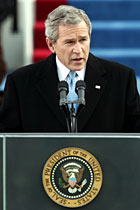
President George W. Bush's inauguration
for a second four-year term marked a ritual familiar to
Americans but often less well understood abroad. The scale
of the ceremony, the parades, and the celebration are universally
comprehended. But the language of the president's address
to the nation invoked ideals that have deep roots in American
life, and their historical context is well worth explaining,
or "translating," for a much wider audience.
Historical Precedents
Historically, the inaugural address provides
a unique opportunity for a newly elected or re-elected president
to go beyond political partisanship and the ordinary business
of governance in order to speak to the entire country and
to embody what President Abraham Lincoln in his first inaugural
described as the "better angels of our nature."
For generations, Democratic and Republican presidents have
invoked the loftiest ideals in speaking about America's
purpose, the religious foundations of these beliefs, and
the indispensable role the U.S. plays, both as an example
and in helping other peoples to achieve the fundamental
ideals of freedom and democracy.
These beliefs reflect the uniqueness of
the United States. Unlike most peoples of the world, Americans
are immigrants or their descendants and are not unified
by a shared ethnicity, race or national origin. Instead,
to be American is to subscribe to the beliefs in democracy
and liberty embodied in the Declaration of Independence,
the Constitution, and the Bill of Rights.
For example, in January 1961, President
John F. Kennedy uttered these stirring words, "Let
every nation know, whether it wishes us well or ill, that
we shall pay any price, bear any burden, meet any hardship,
support any friend, oppose any foe, in order to assure the
survival and the success of liberty." Two decades later,
in January 1981, Ronald Reagan spoke of America as "the
exemplar of freedom and beacon of hope for those who do
not now have freedom." And Bill Clinton proclaimed
in his 1993 inaugural that, "Our hopes, our hearts,
our hands, are with those on every continent who are building
democracy and freedom. Their cause is America's cause."
Each of these presidents invoked liberty
as a God-given right, an idea that goes back to the original
founding of the United States. As long ago as 1630, John
Winthrop, an early spiritual leader of the Puritans, delivered
a sermon calling upon his followers to create a "city
upon a hill" as they prepared to land in Massachusetts.
In 1776, an American revolutionary author, Tom Paine, wrote
that, "We have it in our power to begin the world all
over again." And President Reagan reached back three
and a half centuries to describe America as a "shining
city on a hill."
In short, throughout the centuries, American
thinkers and presidents have not only viewed freedom and
democracy as an example to other peoples, but have encouraged
and supported those who suffer oppression and seek to free
themselves.
Understanding and Misunderstanding
the Bush Speech
In his speech, President Bush proclaimed,
"[I]t is the policy of the United States to seek and
support the growth of democratic movements and institutions
in every nation and culture, with the ultimate goal of ending
tyranny in our world." This statement embodies a key
insight: real democracies do not make war on other democracies,
nor do they nurture terrorists.
Yet some foreign observers have misunderstood
or even distorted the meaning of this statement, claiming
that it signals an imperial crusade to impose democracy
by force. This kind of criticism not only provides an excuse
for dictatorship and oppression, but it completely misstates
the meaning of the Bush speech.
Indeed, the President made clear that, "This
is not primarily the task of arms, though we will defend
ourselves and our friends by force of arms when necessary
... America will not impose our own style of government
on the unwilling ... Our goal instead is to help others
find their own voice, attain their own freedom, and make
their own way." The universality of this message is
evident in the words, "America will not pretend that
jailed dissidents prefer their chains, or that women welcome
humiliation and servitude, or that any human being aspires
to live at the mercy of bullies."
The President acknowledged that the "great
objective of ending tyranny" is a long-term task, "the
concentrated work of generations." Nonetheless, though
the effort is often arduous, there have been considerable
successes in widening the sphere of democratic counties
during the past half century. In this process, the United
States has often played an indispensable part in encouraging
or helping others to free themselves and to establish or
solidify free institutions and the rule of law. The list
encompasses countries in many regions including, among others,
Germany, Japan, Italy, South Korea, the Philippines, parts
of Asia and Africa, most of Eastern Europe, much of Latin
America, and in recent days Ukraine.
The words of once imprisoned dissidents,
such as Natan Sharansky in the Soviet Union, Lech Walesa
in Poland, and Vaclav Havel in Czechoslovakia, testify to
America's importance in raising their spirits and reinforcing
the determination of others like them in their ultimately
successful struggles. Moreover, even where the task still
remains hard and even dangerous, as in Afghanistan, the
Palestinian Authority, and especially Iraq, the ouster of
despotic regimes and the holding of free elections remain
historic achievements.
Ideals and Security in the Post-9/11
World
The September 11, 2001 terrorist attacks
in New York and Washington, as well as the March 11, 2004
train bombing in Madrid, and attacks in Turkey, Indonesia,
the Philippines and other countries are evidence of a deadly
threat. The danger comes not only from fanatical terrorist
groups, but from tyrannies that support terrorism as well
as those that seek weapons of mass destruction.
As President Bush observed, "The survival
of liberty in our land increasingly depends on the success
of liberty in other lands. The best hope for peace in our
world is the expansion of freedom in all the world."
More specifically, as he added in a weekly radio address
just two days later, "We will continue to promote freedom,
hope and democracy in the broader Middle East -- and by
doing so, defeat the despair, hopelessness and resentments
that feed terror."
In short, vital interests, ideals and security
remain closely linked. Indeed, President Bush's words echo
those of Woodrow Wilson, John Kennedy, Franklin Roosevelt
and Ronald Reagan, as they confronted two world wars and
the Cold War. Now, in the face of a new peril, the Bush
inaugural is a bold restatement of American ideals at home
and abroad. They deserve to be understood and valued for
what they truly represent.
ROBERT J. LIEBER is Professor of Government
and International Affairs at Georgetown University. His
latest book, The American Era, will be published in September
by Cambridge University Press. He can be reached at: lieberr@georgetown.edu
The opinions expressed in this article
do not necessarily reflect the views or policies of the
U.S. government. There are no republication restrictions.


