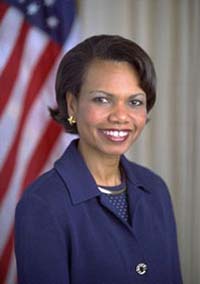
 Washington
– Former National Security Advisor Condoleezza Rice
was sworn in as the 66th U.S. secretary of state at 7:07
p.m. in a White House ceremony on January 26.
Earlier in the day, the U.S. Senate had
confirmed Rice’s nomination as secretary of state
by a vote of 85 to 13, following nine hours of floor debate
that ended January 26.
Previously, the Senate Foreign Relations
Committee approved the nomination by a vote of 16-2 on January
19 and sent it to the full Senate. An immediate vote on
her nomination set for January 20 was delayed after Senate
Democrats indicated to the chamber's leadership they wanted
an extended debate on the nomination.
Rice succeeds Colin L. Powell, a former
Army general and chairman of the Joint Chiefs of Staff,
and becomes the first African-American woman to serve as
the nation's top diplomat.
Senate Majority Leader Bill Frist, a Tennessee
Republican, had predicted at the outset of debate that Rice
would have "an overwhelming majority" of votes.
Debate on her nomination focused extensively
on the Iraq war and Rice's role in advising President Bush
on the arguments for ending the regime of Iraqi President
Saddam Hussein.
The debate, however, coupled with the extended
committee questioning, which took 11 hours over two days,
gave a detailed look of the U.S. foreign policy-making process
and the roles of Congress and national security advisors
in policy-making.
But the two days of Senate debate fell along
party lines with a number of Democrats speaking, for the
most part, against her nomination and Republicans speaking
in support. The outcome, however, was never in doubt.
Senator Diane Feinstein, a California Democrat,
reminded the senators "a president deserves to have
his selections confirmed."
Customarily and by tradition, the Senate
confirms presidential Cabinet nominations without extensive
debate under the long-standing belief that a president is
entitled to have Cabinet officers serving him of his own
choosing.
Senate Foreign Relations Chairman Richard
G. Lugar, an Indiana Republican, commended the Rice nomination
to the full Senate, saying, "We will be participants
in an historic moment that will reaffirm the Senate's role
in foreign policy and underscore the brilliance of the Constitutional
design."
Rice responded to 199 questions during two
days of hearings before the Senate Foreign Relations Committee
-- 129 from Democrats and 70 from Republicans. She also
responded to 191 written questions.
"Thus, Dr. Rice responded to a total
of 390 questions from senators. In American history, few
Cabinet nominees have provided as much information or answered
as many questions during the confirmation process,"
Lugar said. "She demonstrated that her understanding
of U.S. foreign policy is comprehensive and insightful."
Senator Joseph Biden, the ranking Democratic
member of the committee, offered his support of Rice's nomination,
but said that he did so with some reservations, which mostly
stemmed from the current U.S. policies on Iraq.
Senator Edward M. Kennedy, a Massachusetts
Democrat, led off the criticism of Rice's nomination and
the administration's Iraq policy overall saying, "Dr.
Rice was a key member of the national security team that
developed and justified the rationale for war, and it's
been a catastrophic failure, a continuing quagmire. In these
circumstances, she should not be promoted to secretary of
state."
But Senator Joseph I. Lieberman, a Connecticut
Democrat, said "what unites us around this very qualified
nominee in this time of war is much greater than what divides
us."
Senator Kay Bailey Hutchison, a Texas Republican,
said Rice is capable, trusted by the Bush administration,
and has the knowledge of foreign policy from 25 years of
experience.
Rice, before becoming Bush's national security
advisor in 2001, served for six years as provost at Stanford
University and as the school's chief budget and academic
officer. She was also a professor of political science and
is a specialist in Soviet affairs. She served previously
in the administration of the President Bush's father on
the National Security Council.
Merle D. Kellerhals,
Jr.
Washington File Staff Writer


