 REMARKS
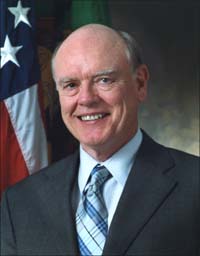
BY TREASURY SECRETARY JOHN SNOW
At this year’s World Economic Forum
(WEF) meeting in Davos, participants will give special attention
to the issue of development, trying to understand just what
makes it happen and what makes change possible. A new Global
Governance report by the WEF, in fact, suggests that 2005
may turn out to be the “year of change,” if
countries can only tap the potential for development that
private enterprise holds.
Under the leadership of President Bush,
the United States has established policies that bolster
and reward the efforts of countries to create the conditions
that lead to genuine development. Our approach is founded
on the belief that countries themselves must create the
conditions necessary for economic growth. Development assistance
can play an important role in lifting people out of poverty,
but the primary driver of growth and development is private
sector investment and trade liberalization.
Moreover, meaningful development requires
structural reforms. The most important of these reforms
are establishing democracy and the rule of law, controlling
corruption, investing in people, and executing sound fiscal
and monetary policy.
The new global consensus on development
reached at Monterrey, Mexico, in 2002 endorses this approach.
The Monterrey Consensus calls on developing countries to
establish sound economic and social policies, and for developed
countries to support these efforts through an open trading
system, private capital flows, and additional development
assistance.
We have seen some encouraging signs of commitment
and progress toward those goals. Nicaragua has developed
a one-stop program to assist investors and entrepreneurs
as they open a business. This program has substantially
reduced the time necessary to set up new ventures, and has
stimulated private sector development and job creation.
In Madagascar, the government has pursued a proactive anti-corruption
campaign to enforce the rule of law when granting permits
for extractive industries, which will have the added benefit
of protecting the environment. The government of Georgia
has doubled its investment in health care and increased
teacher salaries by two-thirds, laying the groundwork for
a healthy and well-educated workforce of the future.
Recognizing the powerful potential of working
with countries that have sound economic and social policies,
the Bush Administration moved decisively to make good on
the commitment we made at Monterrey. Since 2000, we have
increased our development assistance by nearly 90 percent.
We have committed $15 billion over five years to combat
the HIV/AIDS pandemic, a major obstacle to development in
Africa and the Caribbean. We have significantly raised our
grant assistance to the poorest countries, while also increasing
trade and investment opportunities through renewal of the
African Growth and Opportunity Act. We have provided more
than $1.2 billion of financing to secure improved access
to clean water supplies for over 9.5 million people in developing
countries and to adequate sanitation for an additional 11.5
million.
The United States is particularly proud
of the Millennium Challenge Account, an innovative program
that provides development assistance to countries that rule
justly, invest in their people, and encourage economic freedom.
This program makes available $2.5 billion (to date) separate
from and in addition to our current assistance programs.
In his 2006 budget, President Bush will seek additional
funds for the MCA, and disbursements will begin supporting
projects this year.
With these efforts, the United States has
reached well ahead of schedule its Monterrey commitment
to increase development assistance by 50 percent between
2000 and 2006. Yet the Bush Administration recognizes the
imperative to do more. While seeking greater debt relief
for the poorest countries, we will press ahead with key
initiatives in the coming year aimed at supporting individual
nations’ efforts to create the conditions for development.
In advancing a pro-trade WTO Doha round,
we have proposed the elimination of all global tariffs on
consumer and industrial goods by 2015 and substantial cuts
in farm tariffs and trade distorting subsidies. Trade liberalization
on such a grand scale would deliver tremendous benefits
to the world’s poor. We will also work closely with
the Multilateral Development Banks (MDB) to expand their
assistance to the private sector, including small- to medium-sized
enterprises. In addition, we will work to secure improvements
in the business environment of developing countries, a condition
integral to private-sector development, economic growth,
and job creation.
The meeting at Davos is an encouraging sign
of an invigorated international focus on understanding the
causes of poverty. We now know what the building blocks
necessary for meaningful development are. They include economic,
social and political reforms in developing countries. The
United States is committed to supporting those nations that
undertake such reforms. Only with their enactment will we
all be successful in our combined efforts to defeat poverty
and improve peoples’ lives.


