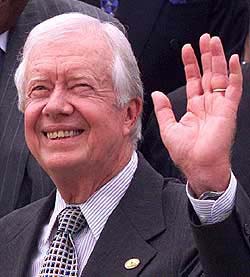
 Former
U.S. President Jimmy Carter called for the stability of
democracy and democratic values in Latin America and the
Caribbean, praising the courage, perseverance and creativity
of people throughout the region. But democratic values are
facing big challenges, he warned, the greatest being the
growing gap between rich and poor, “both within a
country and between the rich North and the poor South.”
“I am concerned that the lofty ideas
espoused in the democratic charter are not all being honored.
I am concerned that poverty and inequality continue unabated,”
Carter added. “I am concerned that we in this room,
representing governments and, in some cases, privileged
societies, are not demonstrating political will to shore
up our fragile democracies, protect and defend our human
rights system, and tackle the problems of desperation and
destitution.”
The Nobel laureate spoke at the Organization
of American States in Washington, DC. He illustrated the
magnitude of the challenges with the examples of Guyana,
Haiti and Nicaragua. Guyana, he said, “remains wracked
with racial tension and political stalemate. Haiti, where
we monitored the first free election in its history and
where the world contributed many tens of millions of dollars
in aid, has been unable to escape the tragedy of violence
and extreme poverty.”
“In Nicaragua, I was privileged to
witness the statesmanship of Daniel Ortega transferring
power to Violeta Chamorro,” he added, “yet today
that country continues enmeshed in political deadlock, and
poverty that is second only to Haiti.”
He also warned on dissatisfaction with elected
governments in the region. “Many still believe in
the promise and the principles of democracy, but they do
not believe their governments have delivered the promised
improvements of living standards, freedom from corruption,
and equal access to justice.”
Carter cautioned there’s the risk
that dissatisfaction with the performance of elected governments
might turn into disillusionment with democracy itself. “Governments
and the privileged in each country must make the decision
and show the will to include all citizens in the benefits
of society.”
The former head of state also asked international
lending agencies to be “more flexible and responsive
to political pressures and social constraints when deciding
conditionality.” He urged multilateral organizations
to better involve citizens and governments in developing
consensus for poverty-reduction strategies, and to help
the hemisphere carry out the mandates of the periodic summits
of the Americas.
“I call on all governments of the
hemisphere to make the democratic charter more than empty
pieces of paper,” he finalized. “I call on them
to make it a living document.”
Source: IDB
(01/26/2005)


