Washington -- President Bush is scheduled
to deliver his State of the Union address on the evening
of February 2 to Congress, the nation and a worldwide television
and Internet audience.
The U.S. Constitution requires that the
president report to Congress “from time to time”
on the “State of the Union.” This constitutional
requirement has evolved into the president’s annual
State of the Union address, which now serves several purposes.
The speech reports on the condition of the United States
both domestically and internationally, recommends a legislative
agenda for the coming year, and gives the president the
opportunity to convey personally his vision for the nation.
Bush’s 2004 speech addressed a variety
of domestic and international issues including the war on
terrorism, U.S. involvement in Iraq and Afghanistan, homeland
security, health care and education. The speech emphasized
U.S. support for democracy and freedom worldwide. “America
is a nation with a mission, and that mission comes from
our most basic beliefs,” said Bush in his 2004 address.
“Our aim is a democratic peace -- a peace founded
upon the dignity and rights of every man and woman,”
he added.
The tradition of the State of the Union
address dates back to 1790 when George Washington, the first
U.S. president, delivered his "Annual Message."
Washington and his successor, John Adams, delivered their
addresses in person surrounded by pomp and ceremony.
But the nation's third president, Thomas
Jefferson, felt that such elaborate displays were not suitable
for the new democratic republic. He delivered a written
message rather than appearing in person. Jefferson's influence
was such that for more than a century thereafter presidents
delivered written Annual Messages to Congress.
In the early decades of the republic, most
of these messages were lists of bills the president wanted
the Congress to enact -- reflecting the tenor of the times
and the practical problems involved in building the young
American nation. The speeches also dealt with the international
situation and America's place in the world.
During the crisis that, more than any other,
threatened the very existence of the American union -- the
Civil War -- Abraham Lincoln wrote perhaps the most eloquent
and memorable of all presidential messages sent to Congress.
“In giving freedom to the slave, we assure freedom
to the free -- honorable alike in what we give and what
we preserve,” wrote Lincoln in 1862.
In 1913, Woodrow Wilson revived the practice
of delivering the Annual Message in person. This was a timely
decision as the United States was on the eve of a mass media
revolution that would soon bring presidents into the homes
of Americans, first through radio, then by television.
With the election of Franklin Delano Roosevelt
in 1932, Americans became accustomed to hearing their presidents
on radio as well as seeing and hearing them on the newsreels
at the movies.
In 1945, the Annual Message formally became
known as the State of the Union address. It also became
a television as well as radio staple as sales of television
sets skyrocketed in the 1950s. In recognition of the power
of television to deliver the president's words to a huge
audience, President Lyndon Johnson shifted the time of the
address from the traditional midday to evening when more
viewers could watch.
The tradition of the opposition response
began in 1966 when two Republican Congressmen, including
future President Gerald Ford, delivered a televised Republican
response to President Johnson’s State of the Union
address.
The broadcast of the State of the Union
address on television and the wide national and international
audience it attracts -- an estimated 43.4 million viewers
watched Bush’s 2004 address -- have changed the fundamental
nature of the message, according to political observers.
"As the audience has changed from inside
the Beltway [Washington, DC] to outside," says political
scientist Paul C. Light, "the State of the Union has
changed from a sometimes windy policy address to a major
campaign event," in which the main audience is the
American voter and those monitoring it overseas, rather
than just American lawmakers.
This will certainly be true when President
Bush delivers his State of the Union address, the first
of his second term, on February 2. The 2005 address will
mark the 216th Annual or State of the Union address and
the 72nd delivered in person. Although there will be a major
focus on domestic issues, both American and overseas observers
will be listening closely to the president's words as he
outlines his vision for the nation in the upcoming year
and beyond.



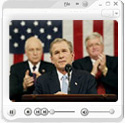
 LIVE
 COVERAGE