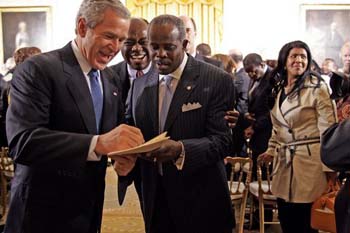
After speaking, President Bush
greets guests during a
ceremony honoring February as
African American History Month.
(WHITE HOUSE PHOTO)
National African
American History Month, 2005
A Proclamation
by the President of the United States of America
Throughout our Nation's
history, the contributions of African Americans
have stirred our Nation's conscience and helped
shape our character. During National African American
History Month, we honor the determination and
commitment of generations of African Americans
in pursuing the promises of America.
The theme of National African American History
Month this year, "The Niagara Movement: Black
Protest Reborn, 1905-2005," honors the grassroots
movement of 1905 to 1910 that was organized
to fight racial discrimination in America. Led
by W.E.B. DuBois, the movement called for voting
rights for African Americans, opposed school
segregation, and worked to elect officials committed
to fighting racial prejudice. Americans today
carry on this movement as our Nation strives
to live up to our founding principle that all
of God's children are created equal.
It is important to teach
our children about the heroes of the civil rights
movement who, with courage and dignity, forced
America to confront the central defect of our
founding. Every American should know about the
men and women whose determination and persistent
eloquence forced people of all races to examine
their hearts and revise our Nation's Constitution
and laws. As we celebrate African American History
Month, we remember how great the struggle for
racial justice has been. And we renew our efforts
to fight for equal rights for all Americans.
We have made great progress, but our work is
not done.
NOW, THEREFORE, I, GEORGE
W. BUSH, President of the United States of America,
by virtue of the authority vested in me by the
Constitution and laws of the United States,
do hereby proclaim February 2005 as National
African American History Month. I call upon
public officials, educators, librarians, and
all the people of the United States to observe
this month with appropriate programs and activities
that honor the history, accomplishments, and
contributions of African Americans.
IN WITNESS WHEREOF, I have
hereunto set my hand this seventh day of February,
in the year of our Lord two thousand five, and
of the Independence of the United States of
America the two hundred and twenty-ninth.
GEORGE W. BUSH |
|
|
The East Room
3:19 P.M. EST
 WHITE HOUSE AUDIO

THE PRESIDENT: Good afternoon and welcome
to the White House -- the people's house. Laura and I are
pleased you're here, so we can celebrate together the 79th
Celebration of African American History Month. We're here
today because of the dedication and persistence of a man
named Dr. Carter G. Woodson.
In the 1920s, Dr. Woodson argued that if
African Americans were to take their rightful place in society,
young Americans of all races needed to learn about the black
contribution to our history and culture. So in 1926, he
launched the first black history week. Today, a movement
that began in black churches and schoolrooms is observed
all across America -- including the White House. Welcome.
(Applause.)
The Civil Rights pioneers of Dr. Woodson's
era also had another dream: a national museum to celebrate
the history and achievements of African Americans. On December
16, 2003, I was proud to sign legislation that will create
the National Museum of African American History and Culture
within the Smithsonian Institution. (Applause.) Laura and
I are pleased to welcome to the White House so many who
were instrumental in the passage of that legislation, and
those who will help us make the museum a reality.
I welcome members of the Congress: Senator
Chris Dodd, thank you for coming; Rick Santorum; Sam Brownback;
and Barack Obama. Welcome. (Applause.) Congressman Mel Watt,
the Chairman of the Congressional Black Caucus is with us.
Thank you for coming, Mr. Chairman. (Applause.) Eleanor
Holmes Norton, delegate from the District of Columbia. (Applause.)
Jack Kingston from the state of Georgia. Welcome, Congressman,
thank you for coming. (Applause.) And, finally, Congresswoman
Carolyn Kilpatrick. Now, I've got a report for you: today
I was with her son, the Mayor of Detroit, who looked mighty
special. (Laughter and applause.) Welcome.
It's such an honor to be with Dr. Dorothy
Height -- you look great. Thanks for coming, Dorothy. (Applause.)
Members of the Council of the National Museum of African
American History and Culture, thank you for serving.
Today is the first day in which folks are
able to contribute to the building of the museum. Laura
and I want to be one of your first contributors, and so
I -- (applause.) You know where to find me. (Laughter.)
I'm honored that members of the original
Tuskegee Airmen have joined us; we're proud of your service.
(Applause.) I told the members of the Tuskegee Airmen how
important the example they set for those who wear our uniform
today and it is a shining example. And you've just got to
know that you've made a huge difference in the lives of
a lot of people.
I also want to welcome Mary Moore, or "Rosie
the Riveter." Thank you for coming; we're proud you're
here. (Applause.) Frederick Douglas IV, and his wife, B.J.,
are with us. Thank you for coming. And Cicely Tyson -- the
ever-beautiful Cicely Tyson (Applause.)
As we celebrate this month, we must remember
a great actor, Ossie Davis, who passed away on Friday. Laura
and I, and many in this room, were honored to salute Ossie
and his remarkable wife, Ruby Dee, at the Kennedy Center
Honors last December. The entire Davis family are in our
prayers, may God comfort them in their sorrow.
I appreciate so very much the chance to
have gone to Goree Island in Senegal. Laura and I traveled
there during my presidency. It was an amazing experience
for us. It was gut-wrenching to see the cramped cells where
Africans were held right before they began their journey
to America in chains. We stood in the "door of no return."
I'll never forget that feeling. It's a door through which
so many innocent men, women and children passed through.
They would be loaded as cargo on the ships for the long
voyage across the Atlantic to a future of slavery and servitude.
You know, it reminded me, standing in that
door, as I think back of standing in that door, it reminds
me how important the museum is going to be, because young
Americans study this shameful period in history in their
schools and they read their textbooks, but most young Americans
will never go to Goree Island or get the same sense that
we felt.
And so when the National Museum of American
History and Culture opens -- and it will open -- visitors
will be able to have a much more vivid sense of what slavery
meant for real men and real women. It is important to know
-- and this museum is going to be a really important museum,
because it's important that our children know that there
was a time in their nation's history when one in every seven
human beings was the property of another. They need to know
how families were separated, denied even the comfort of
suffering together. It's an important lesson of a shameful
period that the young must never forget.
And they need to know that bigotry and discrimination
did not end with slavery; that within the lifetimes of their
own parents and grandparents, Americans were still barred
by law from hotels and restaurants; made to drink from separate
water fountains; forced to sit in the back of a bus -- all
because of the color of their skin. We need to teach them
about the heroes of the civil rights movement, who by their
courage and dignity forced America to confront the central
defect of our founding.
And we all need to learn more about the
men and women whose determination and persistent eloquence
forced Americans of all races to examine our hearts, revise
our Constitution and laws, and make America into the nation
it was always supposed to be.
The theme of this year's African American
History Month is the 100th anniversary of "the Niagara
Movement." Led by W.E.B. DuBois and John Hope and William
Monroe Trotter, the Niagara Movement rejected any accommodation
with discrimination, and challenged our nation to grant
its African American citizens the same rights enjoyed by
other Americans. In so doing, it helped lay a foundation
for the civil rights movement that would change America
in the decades that followed.
Like Dr. Woodson, W.E.B. DuBois placed his
hopes in our youngest citizens -- those who had not yet
been taught to hate. So he directed his call to them. He
said, "We appeal to the young men and women of this
nation ... Stand up for the right, prove yourselves worthy
of your heritage and ... dare to treat men as men."
His appeal echoes across a century, doesn't it? It made
sense then; it makes sense now. And serves to remind us
that while slavery has been abolished and segregation outlawed,
the struggle for justice and equality has not yet ended.
At the start of this new century, we will
continue to teach habits of respect to each generation.
We will continue to enforce laws against racial discrimination
in education and housing and public accommodations. We'll
continue working to spread hope and opportunity to African
Americans with no inheritance but their character -- by
giving them greater access to capital and education, and
the chance to own and build and dream for the future. In
this way, African Americans can pass on a better life and
a better nation to their children and their grandchildren,
and that's what we want in America. (Applause.)
We're making progress, but there's more
work to be done. Today, American schools are no longer separate,
but they're not yet equal. Too many of our children still
face what I have called the soft bigotry of low expectations.
With the No Child Left Behind Act we've raised expectations.
We believe every child can learn and we expect every school
to teach. And we measure. And guess what's happening? Test
scores are going up. There's an achievement gap for minority
children that is closing in America.
Today, the minority home ownership rate
in America is at an all-time high. That's incredibly good
news. I love it when more and more people open the door
to their house and say, welcome to my home -- not just,
welcome to where I live, but, welcome to my home. And we'll
continue to expand opportunity for home ownership in America.
We'll work to strengthen families. Children
from two-parent homes are less likely to end up in poverty
or drop out of school. It's important that families be strong
in America. HIV/AIDS brings suffering and fear into so many
lives, and so we need to focus on fighting this disease
among those with the highest rates of new cases -- African
American men and women. We need to give our young people,
especially young men in inner cities, better options than
apathy or gangs and jail. And I want to thank Laura for
taking on this incredibly important initiative to help young
men realize a great future in America. (Applause.)
You know, in the last half-century, the
cause of liberty has made great strides in this country,
and around the world. At each stage, and on every front,
African Americans have helped to lead this advance. African
Americans struggled peacefully for their own freedom on
the streets of Birmingham and on the Mall here at Washington,
D.C. Some of you were probably there. They have fought for
America's freedom on distant battlefields -- and at this
moment many are serving bravely in Afghanistan and Iraq,
And we respect their courage and we honor their sacrifice.
They know, as we do, that success of freedom
on the home front is critical to its success in foreign
lands. As I said in my inaugural address, we cannot carry
the message of freedom and the baggage of bigotry at the
same time. (Applause.)
We've made progress, and our work is not
yet done. But we can proceed with faith in our country and
confidence in our cause. See, history moves toward freedom
because the desire of freedom is written in every human
heart. As W.E.B. DuBois declared nearly a century ago, "The
battle for humanity is not lost or losing ... The morning
breaks over blood-stained hills. We must not falter, we
must not shrink. Above are the everlasting stars."
I want to thank you all for coming. Thank
you for helping us celebrate this month, as well as to make
it clear to our fellow citizens we have a chance to build
a fantastic museum, right here in the heart of Washington,
D.C., on the Mall -- (applause) -- to stand proud -- and
I'm confident there will be an appropriate web page -- (laughter)
-- for people to be able to tap in. Perhaps you should start,
if you're interested, in going to the Smithsonian web page,
and I suspect there may be an avenue that will direct you
toward this important museum and cultural center, that will
enable our fellow citizens to participate in helping to
build it.
There will be a reception at the end of
the hall here. We're really thrilled you're here. And may
God continue to bless our great country. (Applause.)
END 3:34 P.M. EST


