 Washington
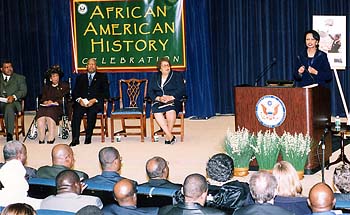
– Condoleezza Rice helped celebrate African-American
History Month February 18 by telling an audience at the
State Department about the importance of her family’s
values -- faith, family and education – and how they
helped her to become the first female African-American secretary
of state.
Rice spoke to an auditorium filled with
members of Congress, African and American diplomats, students
from a local elementary school and others drawn from inside
and outside the State Department. She wove a story composed
of her family’s triumph over adversity and a patriotic
message in which black leaders triumphed by appealing to
America’s principles and values.
By these successful appeals, she said, black
leaders participated in the “second founding”
of America, “an America in which the great civil rights
leaders and those before them gave us the foundation that
we have today that allows for somebody like me to emerge
as America’s secretary of state.”
She asked rhetorically, “What has
made this African American community prosper and thrive
despite the tremendous obstacles since Africans first landed
here in America? I would say it’s a story of faith
. . . it’s a story of family; the importance of family
ties that hold us together.
“When we talk about family, we mean
extended family in the African-American experience,”
she continued. “So black Americans, African-Americans,
have always depended on faith and family and education.
In the most hostile times, in the most difficult times,
that’s what saw us through. But something else saw
us through. And that was a belief in America and its values
and its principles – even when America didn’t
believe in us.”
She recounted her own experience in bringing
that truth to light. Her parents were college-educated,
her father a guidance counselor and eventually the administrator
at the University of Denver (Colorado) “but he got
there and my mother got there because they had parents who
cared about education,” she said.
Rice said the first in her family to really
care about education was her paternal grandfather. “Faith
and family and education came together in Granddaddy Rice,
a poor sharecropper’s son in Ewtah, Alabama. One day
he decided he wanted to get book learning … so he
asked people coming through, in the parlance of the day,
how a ‘colored man’ could go to college and
they said, ‘If you get some money together and go
about 60 miles down the road, there’s Stillman College,
an historically black college, in Tuscaloosa, Alabama. And
they educate young colored men.’ So he got his cotton
together and he took off for Stillman College.”
After the first year, having paid for his
college with cotton, they asked how he was going to pay
for his second year, Rice recounted. “He said he didn’t
have any more cotton and they said he would have to leave.
And he asked (pointing to other students) ‘Well, how
are those boys going to college?’ And the college
official said, ‘They have what’s called a scholarship.
And if you wanted to be a Presbyterian minister, you could
have a scholarship too.’ And my grandfather said ‘That’s
exactly what I had in mind.’”
To the audience’s laughter and applause
Rice continued “And my family has been Presbyterian
and college-educated ever since.
“So black Americans, African-Americans,
have always dependedon faith and family and education. In
the most hostile times, in the most difficult times, that’s
what saw us through. But something else saw us through.
And that was a belief in America and its values and its
principles – even when America didn’t believe
in us.”
Speaking of African-American civil rights
leaders, she said black Americans’ belief in America
and its faith and its principles “was so strong that
[the great black 19th century abolitionist] Frederick Douglass
didn’t appeal outside of America’s principles
and values, he appealed to America’s principles and
values for America to be true to itself. It was such that
Martin Luther King didn’t appeal outside of America’s
principles and values, he appealed to America to be true
to itself in [promoting] progress for black Americans.
“It was true that people like Dr.
Dorothy Height, the only woman among the ‘big six’
[social activists] appealed not outside of America’s
values but to America’s values to challenge America
to be true to itself.” Height, a tiny woman who will
be 93 in March, beamed from the stage where she sat with
two other speakers.
“That should remind each and every
one of us, African American, European American, whatever
we are, that the important thing that the Founders left
to us, was not a perfect America by any means, but an America
that had principles that allowed impatient patriots to appeal
to those principles and to tell America to be true to itself,”
Rice said.
“And now as we talk about the spread
of freedom and liberty to places where it has not yet been
known, we need to remember that human beings are by their
very nature imperfect and therefore human institutions will
be imperfect,” she continued.
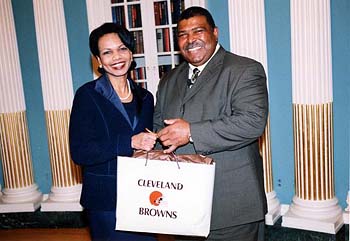
Secretary Rice poses with Cleveland
Browns Coach Romeo Crennel |
In a reference to other nations who have
yet to reach the state of opportunity that America has,
Rice said: “If we have principles of human dignity
and liberty and freedom, those principles will guide impatient
patriots to appeal not outside of those principles but to
those principles to challenge their leaders and their countries
to be true to themselves.
“That’s the story of African
Americans in America, who in appealing to America to be
true to itself, in challenging America to be what America
needed to be, participated in the second founding”
of America, an America in which the great civil rights leaders
and those before them gave us the foundation that we have
today that allows for somebody like me to emerge as America’s
secretary of state,” Rice concluded.
Other African-American speakers included
civil rights activists Bernard LaFayette Jr., Dorothy Height,
and Romeo Crennel, head coach of the Cleveland Browns football
team. The master of ceremonies was Ambassador Ruth A. Davis.
Susan Ellis, Washington File Staff Writer


