Night Shift, centre beat, cold, clear night. I was standing on the corner at the intersection of five roads. It was a busy area after about 10.30 as the pubs were turning out and the Theatre Royal would be letting out its patrons. The area was starting to become a bit congested when I noticed something odd.
The crowd from the theatre was milling about, some leaping off the sidewalk onto the road. Then I saw the cause for this—a yellow Morris Mini was slowly coming down the slight slope approaching the intersection, but was being driven on the sidewalk. The driver seemed to be leaning forward and peering through the windshield.
This was a situation where the regulation speed for a beat copper of 2.5 mph was not appropriate so I dashed across the road. I ran alongside the driver’s door and yauked it open to be greeted by the miasma of booze. I obviously had a drunk driver here!
I reached in and yanked the keys out of the ignition and set the handbrake. The driver was protesting and waving his arms about, yelling, "What’s all the fuss about, I’m not speeding." I hauled him out of the car and draped him over the hood. I turned to one of the crowd that had now gathered and picked a respectable looking bystander. "Take this key and go over to the police pillar on the corner and call the police station and tell them to send a patrol car to take the prisoner and me back to the police station." This was the quickest way I could get him there as he was in no condition to walk.
I watched as the helpful civilian made his way over to the pillar and made the call. Meanwhile, the drunk was muttering and singing snatches of songs in a slurred voice. Taking stock of him I could see that he was in his twenties, well-dressed, blazer, slacks, white, open-necked shirt with a paisley stock at the throat. Obviously a bit of a toff.
The patrol car arrived and one of the PC’s helped me get the driver into the back seat while the other one took the car keys from me and said he would drive the Mini to the station. I would take no bets that her would take the opportunity to have a bit of a trun around the city before taking it into the police garage for safekeeping.
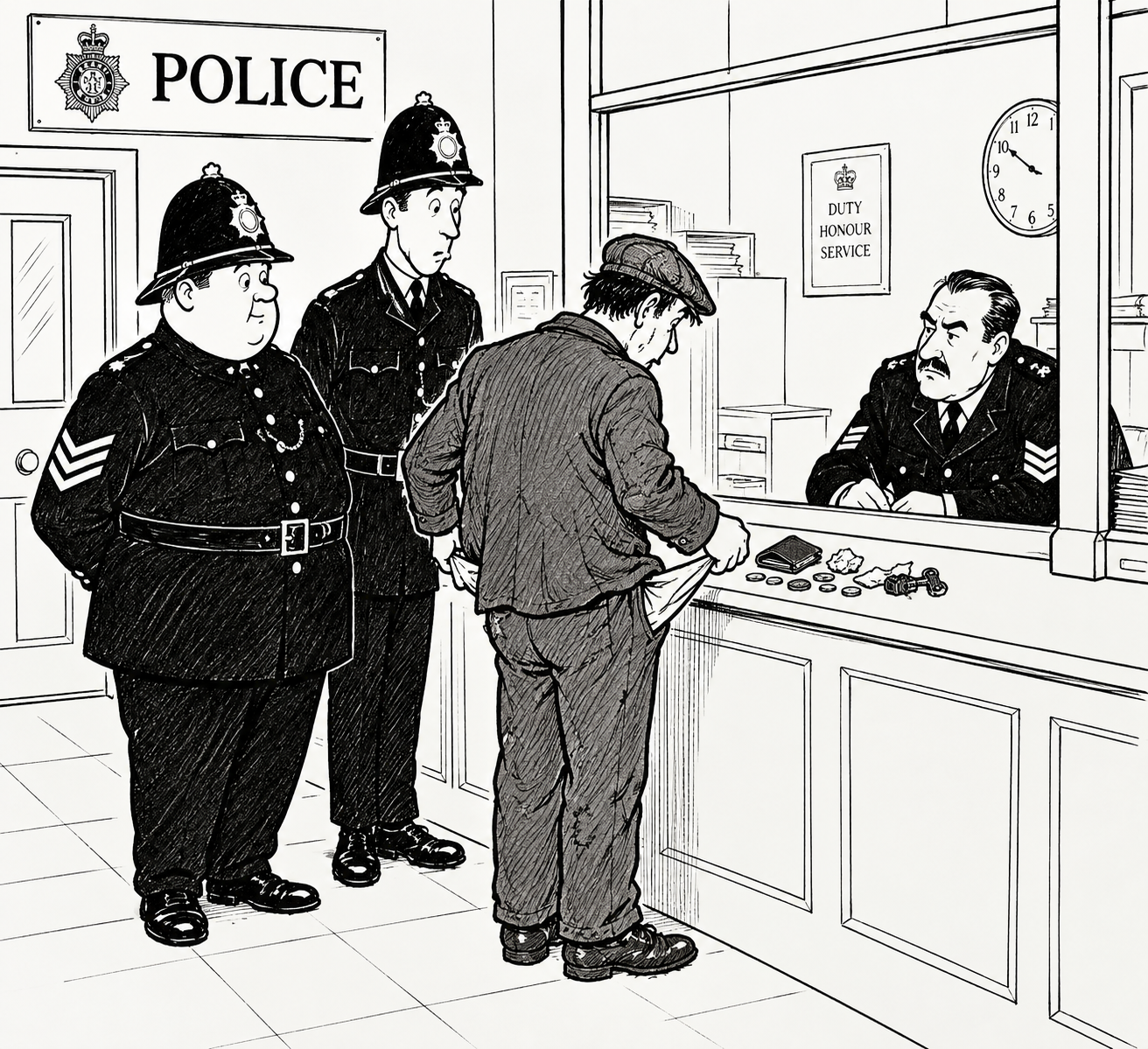
At the station I lumbered him into the Charge Office and told the Station Sergeant what I had observed and the reaction of the offender. The Sergeant looked him up and down and made a few notes, then told me to get him to turn out his pockets and remove his belt and shoelaces before being lodge in a cell.
"OK, chummy, turn out your pockets and put your watch and any rings on the counter." Out came a handful of coins, a wallet from his back pocket, an expensive-looking wrist watch and a signet ring from his right hand. The ring was medium size and had a black onyx panel in which was inset an insignia that looked like a set square and compass. It didn't mean anything to me but the Station Sergeant straightened up and said, "Take him into the Inspector's Office and give him a seat there."
A little nonplussed at this I said, "But he should be lodged in the cells until the Police Surgeon gets here," I protested, "Do as you're bloody told. I'll call the Police Surgeon myself. Go into the Parade Room and write your report," this delivered in an angry tone which belied my further input from me, a lowly Constable.
I sat in the Parade Room and wrote my report, detailing what I had seen and the action I had carried out. This took about twenty minutes. I wandered back into the Charge Office and shoved my report across the counter. The Station Sergeant glowered at me and seemed to get angry when I asked if the Police Surgeon had been contacted. "Of course, lad, but he's going to be delayed," he said, "now go and sit in the Parade Room and wait there. Until I call you." I was a bit puzzled at his sort of 'guilty' countenance.
On the way back I peeked into the Duty Inspector's office and saw the prisoner slumped over the desk, head on his folded arms and snoring away. There was nobody with him and I was getting a bit concerned at the turn of events, but knew that I couldn't do anything about it.
Sitting in the Parade Room, I got up to date on all the latest information in the Police Gazette, the Force's Daily Crime Summary and the various other paraphernalia that kept us up-to-date. Looking at my watch I saw that over an hour had passed since I had brought the drunk driver in.
Screwing up my courage, I went back into the Charge Office to be confronted with a red-faced Station Sergeant. "Don't you bloody ask me where the Police Surgeon is, I told you to wait."
"But, Sarge, if he isn't coming soon we ought to take him out to the Hospital and get him examined there."
"Don't you tell me how to do my job, just get back in there and wait until I call you." He slammed down the ledger he was looking at and glared at me.
Slinking back into the Parade Room, I resigned myself to waiting for what I feared would happen. Would he have sobered up enough to be declared fit to drive? As this was before the days of the breathalyser, it relied on observation and medical opinion.
A further half hour went by and a voice bellowed out, "85, get in here." I scuttled across to the charge room and was surprised to find the prisoner, casually stuffing his property back into his pockets and smugly patting the signet ring back on his finger.
"Sign the Refusal Charge Book, 85." The Station Sergeant glowered at me while I signed the book that detailed all charges that had been refused due to lack of evidence or other circumstances which failed to raise the incident to a chargeable offence. He leaned on the counter with his meaty hand each side of the book and I glanced down and saw that he was wearing a identical ring identical to the offender's. "Now, call this gentleman a taxi, sharpish," he said.
Looking at the offender, swaying on his feet, the glassy look in his eyes and the smug grin in his face, I lost any inhibitions about rank and said, "He's been certified sober, he can call a taxi his own bloody self." With that I slammed out of the office and strode back to my beat.
For the rest of the shift, I seethed over the injustice that had been done and the it dawned on me that in my naivery I had missed the secret to my failure to get the charge accepted. I determined not to let this get me down.
Unbeknown to me at the time, I was to get some vindication the following Spring.
Fifty percent of the funding for a police force is provided by the Home Office and fifty percent by the local authority. In order to ascertain that a force was being run efficiently and effectively an annual inspection was carried out by the government through Her Majesty's Inspectors of Constabulary. These all-powerful individuals were selected from retired Chief Constables and the HMI's inspection was a time of hustle and bustle.
The morning of the inspection was carried out by an inspection of the various sections of the Force and talking to members as they carried out their allotted tasks. The afternoon saw as many members as possible gathered in the Force conference hall where the various books of the Station would be opened and the HMI would pick a recorded incident and call for the officer(s) who dealt with it to stand up and answer questions about the event. The questioner would then dissect the case and reveal anything that could be improved on.
The HMI randomly selected one of the ledgers and opened it up. I saw it was the Refused Charge Ledger. My throat got a bit tight and my palms became sweaty, but, no—he wouldn't pick on me???!!!
"Hmmm," came the plumby voice in affected cultured tone. "Let me see. I have a refused charge for driving while under the influence of drink here." He looked up. "Is PC 85 Roberts here?" There was no real question in his tone as he knew that the odds of me not being there were pretty well zero.
I stood and stammered, "Constable 85 Roberts, Sir." This while standing stiffly to attention.
"Relate to me the circumstances of this offence and what led to the charge being refused Constable. You may use your notebook if you wish," delivered in a kindly tone.
I had no need of the notebook as this was a case engraved deeply in my memory. "I was on Night Duty and stationed at the intersection..." The whole story came out and it got to the juicy parts I could sense quite a few people in the room shifting uneasily in their seats, including one or two of the senior officers seated at the top table.
When I finished there was a velvet silence for a couple of minutes and then the HMI spoke. "Huruph! There appear to be some unusual features about this incident, and though I do not intend to go into it right now, you can rest assured that there will some explanations forthcoming to me at a later stage." This was delivered in a wintery tone, accompanied by a sardonic smile.
"Thank you, Sir," I said and sat down breathing furiously.
The PC sitting next to me, an old-stager with many years service, muttered to me, sotto voce: "Good on you lad, but you know you've fucked your career."
Whether he was a prophet or not remained to be seen.