Wednesday Late Shift was notoriously quiet and being the only Detective on duty I was at a bit of a loss as to how to occupy my time. I was still a bit wet behind the ears, having been back from the Detective Training College just a month or two. The paperwork had been caught up on, the Station was quiet and I decided to mooch around the town and check a few hotels.
Each detective had a number of hotels allocated to him which he checked periodically in case they had someone on their books who warranted a look at. One of mine was The Femley, a better-class of hotel and rarely bringing any trouble our way.
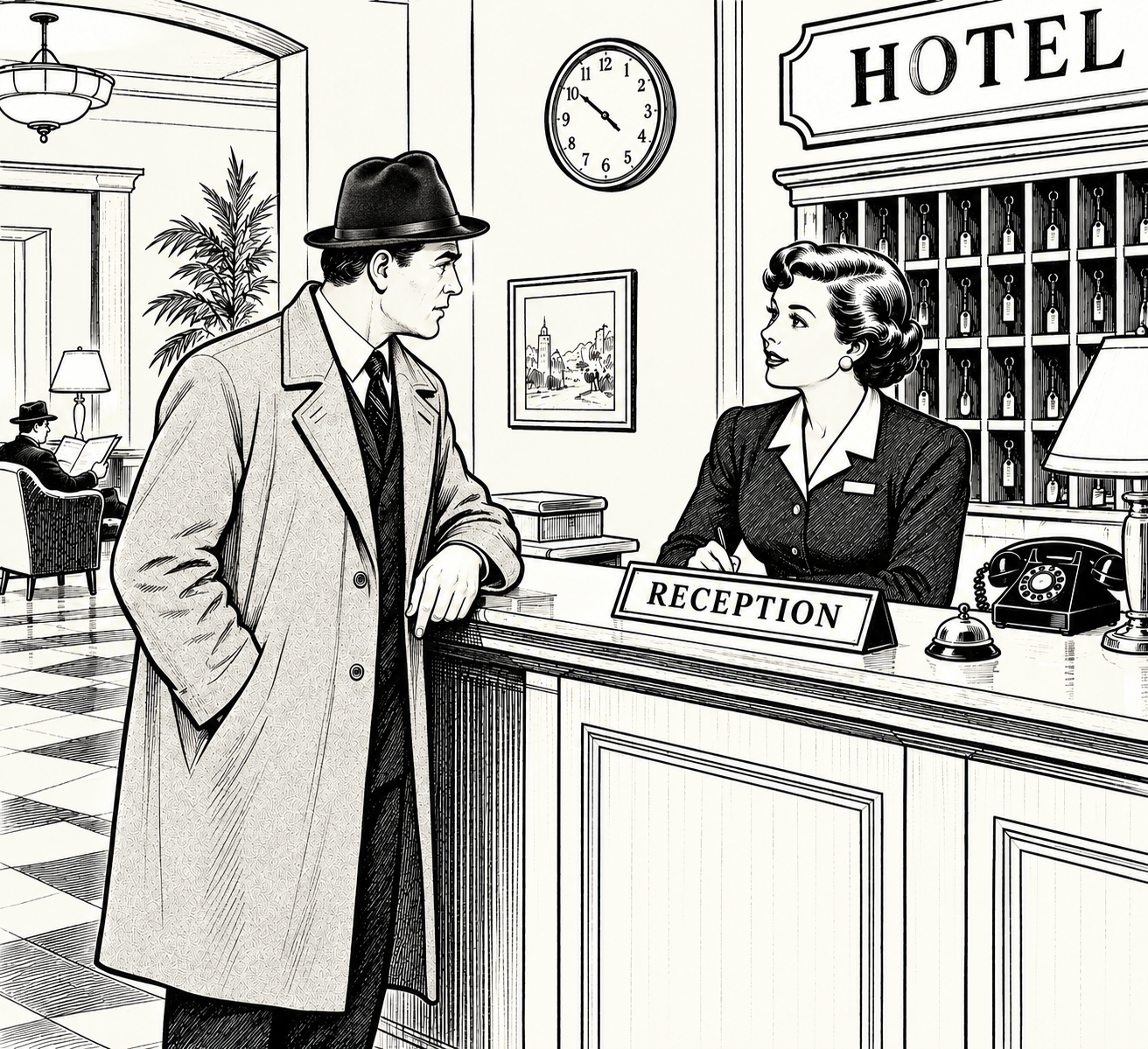
I checked in with the receptionist and asked her of she had anyone who was causing any concern. She said, in a parody of an Upper-Class accent, "We have a gentleman in Room 302 who has very little luggage and is running up a good bill in bar and restaurant charges. He is booked in under the name of Albert Johnson. He's been with us for three nights and doesn't seem to be here on business."
"OK," I said, "Give me a description and I'll run the rule over him."
"He's in the bar now, the gentleman in the green tweed suit, check shirt and dark red knitted tie. I notice that he drinks a lot of good brandy." This said with a disapproving facial expression. Little did she know that it was aware that she came from a part of the city that could at best be described as lower working class, her Old Man having done time for burglary years ago. Still, she had to be given full marks for trying to raise her station in Life.
I went into the Lounge Bar, a tastefully decorated room with oak panelling, discreet lighting and gleaming polished brass. There weren't many people in there and my target was easy to spot from the description the receptionist had given me. He was about 5' 11" in height, slim build, with dark brown wavy hair, worn long with grey at the temples, giving him quite distinguished look. A military-looking moustache adorned his upper lip, and he sported a large signet ring on his right hand and was quietly disposing of a large brandy.
I ordered a half pint of ale and supped it slowly, drinking in the physical characteristics of the suspect who called himself Albert Johnson. When I'd finished my half I quietly left the bar and hurried back to the Station, just a block away.
Grabbing the latest issue of the Police Gazette issued by the Metropolitan Police to all Forces in the country, I scanned the pages looking for something that would fit our hotel guest. Sure enough, an entry from the Sussex Constabulary detailed three offences of Credit by Fraud in their jurisdiction. The description of the suspect fitted my man to a tee and the aliases used were remarkably similar; Albert Jamieson, John Albertson and James Albertson.
Scuttling back to the hotel, I went into the bar and there was my suspect still working on a brandy. I strolled over to him and introduced myself and told him that he answered the description of a man wanted for Credit by Fraud in Sussex. I gave the usual formula for arrest, "You are not obliged to say anything etc., etc."
Smiling, he nodded in head and then hit me with a thunderbolt. "Dear boy," he said in a cultured voice, "I'm afraid it's a bit early for that," drawing back his shirt cuff he glanced at his watch. "D'you see, it's only 8.0 p.m. and under the Debtors Act of 1869, you can't arrest me found committing the offence until after 9.0 p.m."
Unfortunately the bugger was right. In my enthusiasm I had forgotten this anomaly in the statute that made his actions criminal. Obviously, he had been through the hoops a number of times before.
"I tell you what, old son, I've still got a bit of the ready cash on me, so why don't we go and have a good meal together and then, at 9 o'clock, you can nick me. That way, I'll have a full belly and you'll have a good nick to your credit."
Dumfounded, I realised that it was really the only solution as I couldn't arrest him and following him around for another hour was out of the question, so I meekly said, "OK then, but not here or you'll put it on the bill that you've run up."
We left the hotel and went to a nearby steakhouse that had an excellent reputation and settled in to a good feed of steak and mushrooms etc., accompanied by a bottle of wine. After we had cleared our plates, I asked him, "Do you want to tell me the story, off the record?"
Wryly, he answered, "You'll learn it soon enough when you get my record from The Yard." This referred to the Criminal History Sheet that would be sent on my reporting his arrest; "However, if you want it from the horses mouth, here it is."
He had been a Captain in the Royal Army Service Corps during the war and had been demobilised into a civilian life for which he had no real skills other than a bent for organisation. The only job he could find was working in a large laundry which catered to a number of hotels and hospitals. His service experience had made him realize that the company was badly constructed to deal with the enlarging business and he suggested a number of changes that would improve efficiency.
His suggestions were acted on and he was asked if he would accept the position of Co-ordinator for the company. This was a salaried position and would be a substantial rise in pay for him. In accepting it he placed himself in an awkward position. In his capacity as a worker, he was paid weekly. As a salaried staff member he would be paid monthly. An account was opened in his name at a local bank and he was given a cheque-book.
This is where pride guaranteed a fall and he started issuing cheques, knowing that the funds would not be available. "If only I had the commonsense to ask for an advance on my salary none of this would have happened." He heaved a sigh. "But I guess it was not meant to be, at least for me."
He had been sent down for six months for False Pretences, and that was the beginning of a career as a Fraudaman. The intervening years had seen him convicted on four more occasions, each time having numerous offences Taken into Consideration.
This was a way of "clearing the books" for a criminal. It meant that he would be sentenced for all the offences in the single trial. It also cut down on the paperwork and was beneficial all round. The individual police Forces could close the files and the criminal now had no fear of being charged with the offences on his release.
However, in Albert's case he was liable to a term of Preventive Detention. This was the final stage in a system which dealt with repeat offenders. The first stage, Corrective Training, was the treatment meted out to a person who had committed a number of offences since adulthood which would garner a prison time of two years or more. This was a mandatory three to five years incarceration.
The theory was that the offender would be given access to courses which would prepare him for a full and productive life after prison. Due to lack of facilities it became more of a University for Criminals. Each learning from the other the subtle nuances of criminal activity.
Albert had come out of prison more prepared for crime than he went in. Unable to find a decent job he took to crime again and his latest spree would land him a substantial sentence in a hard institution, Wormwood Scrubs, Pentonville or even Dartmoor. Not a future to be faced lightly.
We both lapsed into a sombre silence and after a few minutes Albert said, 'C'mon, let's get it over with.'
His appearance at Magistrates Court the following morning saw him remanded in custody for sentencing at the Quarter Sessions High Court where he received eight years with no time off for good behaviour.
I visited him in his cell before he was taken away and thanked him for his understanding of a young, inexperienced detective. 'No, mate. It's me should be thanking you for a last hearty meal.'
I had learned a lesson in not being too hasty and tempering justice with compassion. The ironic thing about it all was that I received a Chief Constable's Commendation for "astute detection."