Nothing was happening.
Bloomfield Park was a Dead Beat. Nothing ever happened there. A middle-class suburb on the outskirts of the city, it was really just a bedroom community. A strip mall and a few small manufacturing businesses made up the commercial section. Everything was closed up by six o'clock. For the officer assigned to the beat it was more a case of wandering around, keeping the one-hour "points."
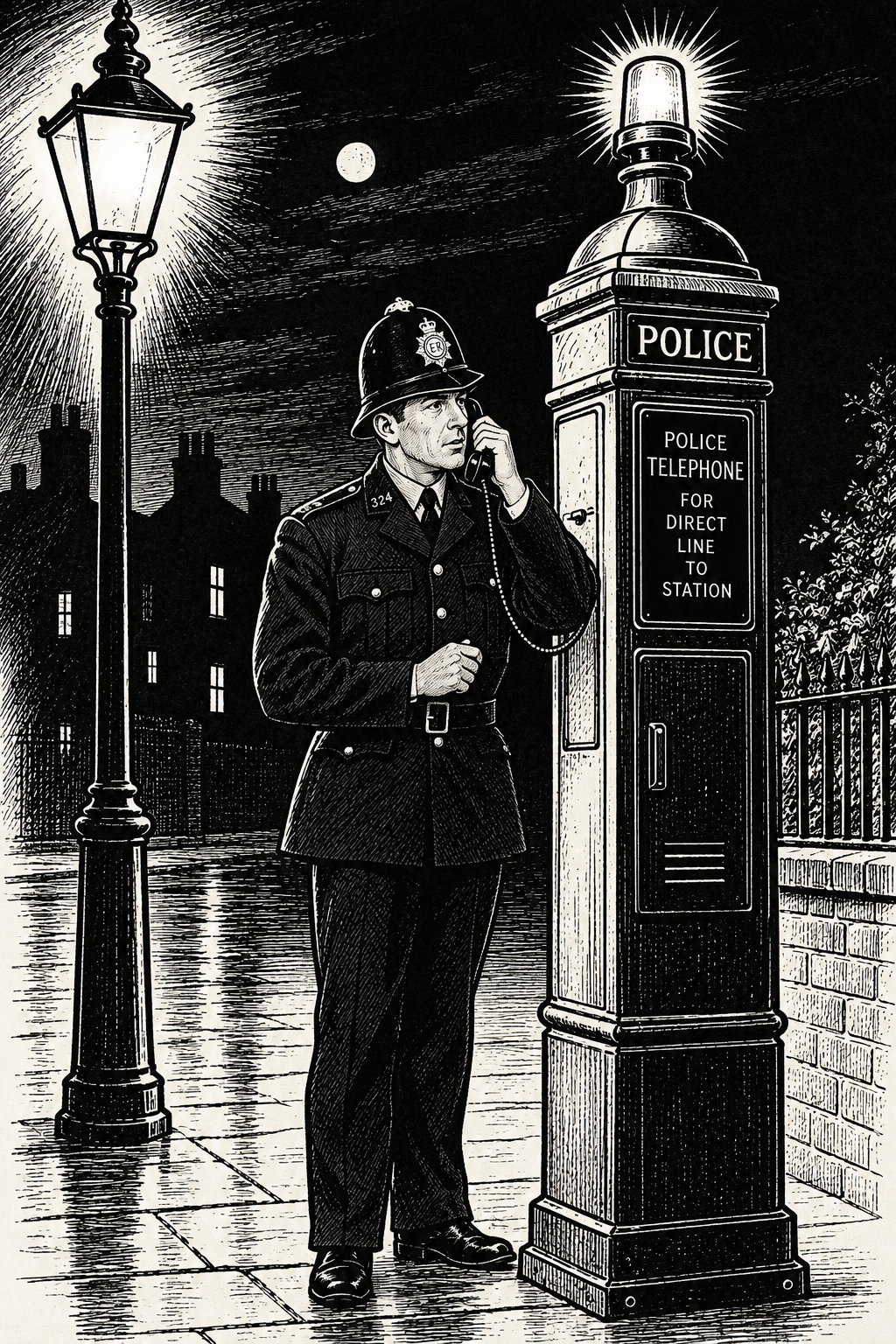
Police "pillars"(1) were placed at strategic points around the foot patrol area. They were the coppers' lighthouse. These pre-determined "points" ensured that the beat officer would be close to a particular pillar at a particular time as per his Beat Card. About six feet tall they had a wide circular base, a tall stem, and on top a circular cage with mesh sides housing a red filtered light. Directly linked to police headquarters, they could be activated to provide a flashing beacon to alert any police officer in the area. The rear of the cage housed a telephone handset that allowed the beat cop to converse with the station. These were the days before personal radios, one of the advances that was in a dim and distant future.
I was on the Late Shift, 2.0 pm to 10.0 pm. It was getting on for 9.0 pm and nothing had happened in the preceding hours except taking care of a lost child. He had wandered away from his mum while she was busy gossiping in one of the shops. When she spotted me she ran up, frantically waving her arms and yelling, "I've lost him, I've lost him."
Meanwhile the tear-stained face of the five-year old peered out from behind my leg, which he was clutching tightly. I had earlier calmed him down by giving one of the candies that I habitually carried around in preparation for such an emergency. Nothing like a gob-stopper to cut off a wailing kid. This was before the days of Don't Talk to Strangers From a Stranger.
"It's OK, Madam," I said, "He's quite safe; we've had a good chat about him wandering off. Kids get bored of hanging around while grown-ups exchange the local news about Who is sleeping with Who. It's no easy for you to forget he's there (hoping she'd take the hint)." Off they went, her holding his hand and he looking up into her face with fear and trepidation. Case closed.
The rest of the shift passed completely without event—almost! I made my points, checked my property, shaking hands with door handles and gently shouldering doors to make sure everything was secure. I was making my way towards the edge of my beat before heading back to the station. I saw the flashing red light on the pillar on the next corner and quickened my pace.
"85," I said. We never used names in those days, being a number made it a lot easier for bookkeeping.
The burrid voice that came out of the handset monotoned, "Gut an SDN for you."
My pulse quickened, my palms became sweaty and my stomach clenched, my mouth went dry. I had never done one of these. One of the most dreaded duties for an inexperienced copper, the SDN was a notification to a relative of the sudden death of a loved one. I'd heard other coppers talk about it and there was always a deep sadness when they spoke of it.
"A Mr. Johnson, 43 Oldfield Avenue, is the recipient. His misus has died at Greenhill Hospital. She's been in there a couple of weeks. Confirm it when you report off shift. There's no other relatives listed at the hospital." With that he clicked off, leaving me trembling. No doubt that anyone seeing me then would have though that I didn't have a drop of blood in me as I was sure that all the blood had drained to my feet.
This was confirmed as my leaden steps dragged me on to my first encounter with one of the realities of policing that I was to become very familiar with—Death.
35, 37, 39, 41, 43! I stopped outside a neat little row house, the classic white picket fence, tidy flower borders to the pathway leading to a front door with the alto-classic brass lions-head knocker. I slowly made my way up the path. Drawing a shuddering breath, I reluctantly reached for the knocker. I could just harvest the strength to lower it. The sound it made was a death-knell.
The hall light went on and the door opened. The slight figure that stood before me was an elderly man, probably in his late-seventies, early-eighties, short, with snow-white hair and a face that was wrinkled around the eyes, more from laughter than age. His cardigan was obviously a favourite garment, with the drooping pockets and one button done up out of sequence, making it's [its] neck gape a little.
"Mr. Johnson?" I croaked. I couldn't get another word out. My image of him swam in front of eyes that were filling up with tears.
"Yes." A long pause while he searched my face, gave a sigh and said, "She's gone, isn't she?" He looked at me with understanding, a kindly expression on his face. He reached out a hand and grasped my arm, gently, pulling me into the hallway, "C'mon, I'll take you into the sitting room and make us a cup of tea."
He led me into a room which was a duplicate of my Gran's. Over-stuffed red velvet settee and chairs, with crochet anti-macassars face on the arms and seat backs, full-length drapes and framed family photographs on every flat surface.
"Sit you down, lad, I'll put the kettle on." He left the room after settling me in one of the chairs.
Coming to terms with my grief for a lady I never knew, I managed to regain some composure. Mr Johnson came back into the room with a tray. He set it down on the small table between the two chairs and sat down in the chair opposite. He had two tea-cups, a pot with a crochet cosy on it, complete with white pom-pom, sugar and milk, and a plate of digestive biscuits.
He poured me a cup and one for himself. "Help yourself to milk and sugar, son, and have a biscuit. It'll help."
I spooned in two sugars and stirred, my trembling fingers making the spoon ring on the sides of the porcelain cup. I picked up the cup but put it down again without drinking.
"I was in to see her this afternoon," he said, "and I knew that she didn't have long really, but I had hoped she wouldn't linger too long. It was the cancer, you see. She was diagnosed with it just three weeks ago, in the pancreas, and they say that one is quick to be fatal."
He lapsed back into the chair, elbows on the arms. "I've got to make the arrangements for her funeral and let my daughter know."
"They said that there was no other next-of-kin listed on your wife's life," I said, a bit puzzled at this.
"Ah, that was because she left home as a young lass and moved up to Scotland and got married. I had an address for her and wrote her letters but she never answered them. You see, she had a falling out with her Mum over a boy she was seeing and, being a headstrong lass, she went out and got married at the Registry Office. He slipped me the address they were going to in Edinburgh. I wrote, but we never heard from her."
"Give me that address and I'll see what I can do."
I wrote the address down in my notebook and got up to leave. "I'm on this beat tomorrow evening and I'll call in and let you know."
I left after exchanging warm handshakes, feeling much better. I now had my first SDN under my belt and knew that I could do something to help.
Back at the station I confirmed the notification with the Station Sergeant and asked if I could stay on and request assistance from the police in Edinburgh. I explained the situation and that I would use the Teletype to contact the Edinburgh Police.
"OK, 85, but you realize that there's no overtime in it for you?!" He scowled at me, intimidation on his face.
"Yes, Sarge, I know that."
They were pretty stingy about attacking the overtime budget, but the job came first and I was determined to do my best for the old man.
I went into the Comms room and sat at the machine. The Teletype was a new addition to the Force's arsenal of "modern" equipment for that time. It allowed forces to communicate with each other through a dedicated network of connections with a terminal at each end and an electronic keyboard like a typewriter. I had learned to use one of these in the Air Force and was very familiar with it.
I contacted Edinburgh and gave them the information, asking them to confirm when they had located the daughter, then went off shift and off home for a disturbed rest.
The following afternoon we paraded for duty and I was assigned to Bloomfield for my beat. The Parade Inspector told me that the daughter had been contacted and would get in touch with her father. I managed to scrounge a lift from the Motor Patrol to drop me off at the edge of my beat, not something they were authorized to do, but sometimes did anyway. It would probably cost me a pint later on.
I saw that my beat card wouldn't take in Mr. Johnson's street until later on in the evening so I plodded around at the regulation 2.5 miles per hour, hand clasped behind my back. Every so often I would pause on a corner and survey the scene, rocking gently on my heels as seen in all the popular tv shows. It actually helped to relieve the muscle ache that creeps in during a shift.
Again, nothing happened on my beat.
At 2030 hours I found myself on Oldfield Avenue and started down the sidewalk. 39, 41, 43, up the path and a knock on the door. It was opened by a lady in her fifties and it was obvious that she was Johnson's daughter.
A smile lit up her face and she said, "You must be my Dad's policeman, come in, please."
She took me into the now-familiar sitting-room and Johnson bustled in from the back of the house. "I'm glad you came. I want to thank you for contacting my daughter. She came right away and she'll be staying with me until everything is sorted out, then I'm going up to Edinburgh to meet her family. She's got three children and I'm going to spend some time with them."
They looked at each other fondly and she put her arm around his shoulder and hugged him.
I left, feeling good about my first SDN. Bloomfield Park would never be a Dead Beat for me again.