For me to have become a portrait photographer is as much of a surprise to myself as it is to my friends. Yet, on reflection, I realize that my involvement with people over thirty years of police work, in three countries, has developed a deep interest in people. They are essentially the raw material to the portrait photographer’s expression of art, as much as they are to the police officer's service to his community.
The focus of one's interest in a particular area often have their roots deep in the past. For me, it began as a young detective in a city police force in England, an England still recovering from the ravages of the Second World War and in the clutches of an austerity that nurtured the development of a criminal element in society who were beginning to take a professional attitude towards crime.
In the small force in which I served, each detective had an additional specialty. After completing the long, hard grind of the detective training school, I expected something exotic, like Drugs or Special Branch. However, this was not to be and I was told that I was to become a police photographer and scene of crime examiner — this regardless of whether I had any inclination towards this field, for, in those days, orders were orders, to be obeyed at all times without question!
Accordingly, I arrived at New Scotland Yard to begin the three-month course in fingerprints, photography and scene of crime examination. The fingerprints section of the course was a little dry, and I looked forward to the photography and scenes of crime part with some misgivings.
To my surprise, when I reported to the Instruction Block for the photography course, I found that I was alone. This impressed me no end. To think that I, a young detective from the boondocks, was to be given personal tuition in a subject as complex and technical as photography increased my awe for facilities at "The Yard." I commented on this to the instructor, a bluff, north-country detective inspector, but his reply brought me down to earth. "There were supposed to be seven bloody Nigerians on't course wi'ye, lad. It seems they've 'ad a revolution and none of 'em 'ave turned oop."
So began my relationship with a man whose skills as a teacher were superb. Not only did he drill me in the complexities of calculations for exposure compensation, in bellows-extension and the effects of the breakdown of the Bunsen-Roscoe Law of Photo-Chemical Equivalence; he also instilled in me the ability to see as a photographer and to put that extra something into my work which made it mine.
The course syllabus was completed in a couple of weeks and for the rest of the six weeks we explored the areas of photography not normally covered on a course of this type. From this dedicated teacher I gleaned those small nuggets of knowledge and tips which every photographer develops over years of practice, but which are deemed too insignificant to formalize in instruction. He awakened in me an interest in photography which did not aim in a specific direction, but which gave me the groundwork on which to build my own likes and inclinations into a specialty that would not surface for many years.
 | |
The following years were filled with the events endemic to the life of the young detective — the shift work, long hours of overtime, too many cigarettes, too much beer, and a contact with a criminal society which was more experienced in its chosen profession that I was in mine. It has oft been said that life is a learning experience — and learn I did — to the extent that I formed the definite opinion that, in the case of most of the characters I dealt with, intelligence had been supplanted by animal cunning.
In those days an investigation would lead to a suspect and to the subsequent questioning of that person in an effort to obtain a confession of guilt. Based on the evidence painstakingly gathered during the enquiry, the questioning almost inevitably led to this confession — The Cough. It became a battle of wits, enjoyed in a perverse way by both parties, involving much posturing and many psychological tactics, albeit unconsciously.
My youth was against me in dealing with older and far more experienced criminals who would attempt to establish their superiority by addressing me as "sonny boy" or "lad." For my part, I tried to use what I thought was a superior knowledge of the English language to confuse and confound — and anyway — I knew that they had committed the offence, they knew they had committed the offence, so it was a matter of time and patience before those magic words were uttered: "All right, guv, I'll tell you all about it . . ." (They did, in fact, use those words — they are not just the fruit of the scriptwriter's art!) Then followed the formal statement under caution, taken in complete accord with the Judges' Rules — said by cynical policemen to be "for the obedience of fools and the guidance of wise men."
During those cigarette-hazed, tea-sodden sessions, I unconsciously learned the techniques of what are now called, in chapter headings, "Interpersonal Relationships" and "Interpersonal Sensitivity"; really, just the ability to relate to people within a range of subjects of their choosing; to chat with a criminal outside the bounds of our official relationship until he was convinced that I was, after all, a human being — and learning in the process that he was also!
From this aspect of the job I found I was able to regard people as a whole and not just as the part I was officially dealing with and I formed the opinion that people are neither wholly bad, nor wholly good. As an illustration of this, I offer an experience which taught me that humble pie sometimes doesn't taste too bad — especially when you have to eat it.
Shortly after my elevation to the exalted rank of Detective, I was on the late shift, checking out one of the hotels assigned to me. It was a good-class hotel, offering comfortable rooms, excellent food and a congenial bar lounge. Accordingly, it was perfect place for a con man to practise his art and enjoy a good living too. The receptionist deigned to speak to me on production of my warrant card — policemen still ranked with the downstairs maid in those days. However, she told me of a guest who had booked in for a week, was running up a fairly substantial bar check, and had very little luggage in his room. She discreetly pointed him out in the bar, he sipping a double brandy and exuding an air of prosperous self-confidence. I noted his description and the name he was using and scurried back to the C.I.D. office to check the Police Gazette. Sure enough, my client was circulated as being a suspect in a string of hotel frauds throughout the country.
At this stage, I must enlighten you on one of the absurd complexities of British law, as it existed at that time. In order to arrest a person for the offence of Obtaining Food and Lodging Fraudulently, under the Debtors Act, 1869, one had to either possess a warrant for the offender's arrest, or arrest the person whilst he was committing the offence — provided it was after 9:00 p.m. Oblivious to the time and blinded by the prospect of a good catch — I raced back to the hotel.
Completely at his ease and enjoying the convivial atmosphere of the discreetly-lit lounge bar, my suspect was sipping yet another double and benignly surveying the scene. I approached him (policemen never "go over" to anyone) and gave him the formula — IAMAPOLICEOFFICERANDHAVECAUSETOBELIEVETHATYOUARECOMMITTINGTHEOFFENCEOFCREDITBYFRAUD - breath - YOUARENOTOBLIGEDTOSAYANYTHINGBUTANYTHINGYOUSAYMAYBEUSED . . . delivered in the best tradition of the British Police.
Smiling gently, he flicked back the cuff of his expensive tweed suit and consulted a discreetly elegant gold wristwatch (both having undoubtedly been obtained with rubber cheques) and said, "I'm afraid you're in a spot of bother, old boy, d'ye see it's only eight o'clock." My mind raced and all the hours spent on the Detective Course learning section after section of Acts by rote, came flooding back. No warrant – found committing – after nine o'clock! My Adam's apple stuck in my throat and I had a vision of the D.I. sentencing me to bicycle patrol for the rest of my service, when my client deprecatingly waved a hand and said: "Don't worry, old chap. I've had a good run and it's time I went back inside. I tell you what, I've got a few pounds left and I suggest we have a good meal, then we can do this all again after nine o'clock."
And that's just what we did – the con man and the young detective sat down to a sumptuous meal in the city's finest restaurant, waiting for time to tick by. After my initial shock I was able to relax with a most entertaining character and I began to learn by what quirks some people are saddled with just insufficient moral fibre to prevent them from leading a life of crime. Bless you, George, wherever you are! I must say that the humble pie was superbly cooked and delightfully served, accompanied as it was by a first-class beaujolais – but humble pie nevertheless.
I was content with my lot and life looked pretty good, but as always, something will come along to upset a nicely arranged apple cart. In my case, it was the spectre of regionalization of police services in the interest of greater (?) efficiency. It was the death-knell of the small force in which I served by its absorption into the surrounding and larger county force. It became well known that with the change, members of the city force would gradually be transferred out, as the city was regarded as a plum.
Faced with a possible move to a small town and investigating thefts from gas coin meters or throwing a cordon around the town for the major crime of cycle theft, after much discussion with my long-suffering wife, we decided to initiate our own move. Move we did – to the other side of the world – New Zealand.
The move is a story in itself, to which any young couple with two small children could attest, but suffice it to say that 1965 saw us settled into our new country. I had gone through Police Training College again and was serving in the country's largest city and major seaport, piloting a police cruiser and hustling drunks – back to basics.
After a couple of years of this, I was lucky enough to secure a position in the Criminal Registration Branch – not, I hasten to add, the Branch with which the criminal registers for employment, but the one dealing with the scientific aspects of criminal investigation and its illustration through photography.
As the country's largest city and major seaport, Auckland had all the problems associated with a population of some 800,000 people of mixed ethnic origin. The three-man photographic section was a busy one, handling homicides, rapes, robberies, break-ins and the publicity and public-relations photography associated with a business employing 1,000 men and women. Although busy, I loved the work and the seeds planted so many years before at New Scotland Yard began to germinate.
In an effort to assess the quality of my work, I began seeking qualification with recognized professional photographic bodies in England, the U.S.A. and New Zealand. This search for a recognizable standard of professionalism also spurred me to seeking advancement in the specialized field of photography with the police, where, at that time, no possibilities existed. The ensuing battle for recognition forced me, and the few prepared to persevere, to prove ourselves under the existing system. The examinations in Police Law, Statutes, Administration, Police and Detective duties contained not one question on photography and its application to police work. The result of all this was my promotion to Officer in Charge of the Photographic Section in the rank of Sergeant.
During all this, I stumbled across portraiture as a form of release from pressure – what better release for a photographer than photography? I guess that this inclination enjoined me, when photographing victims of assault, to seek that "something extra." I found that talking to them about the incident produced some emotional feeling in what otherwise strictly a record shot.
About this time, a well-known English actor came to New Zealand for a year's sabbatical. He had been the star of a long-running TV cop show, in which he had become totally identified with the character of the arrogant, ruthless Detective Chief Superintendent he played. At a luncheon in his honour, I asked him if he would sit for me. His consent, and the satisfying result, were well beyond my expectations.
This started me off on an association with people that we normally only see on the small - or large - screen, or read about in magazines. It enabled me to offer them some small tribute for the hours of enjoyment they have given me, or to examine the character of a person newly met.
I have found that my life has been enriched by meeting celebrities – and finding that they are essentially ordinary people; and by meeting some so-called ordinary people and finding in them the qualities that make them "celebrities." It has exposed my family to association and friendships with people we could not have met during the normal course of my vocation as a police officer.
Through the eye of the camera I have been privileged to record my impressions of these people to serve as a memento of the enjoyable hours spent with them. Photography has enabled me to develop relationships with people based on a closer scrutiny of their character and personality than one would normally make, to find the source of richer relationships.
It is my hope that you, the reader, will share in my enjoyment. For those who are, or who hope to be, portrait photographers, I humbly proffer my experiences in the fervent hope that they will enhance your enjoyment of portrait photography and people.
David Roberts, ARPS
Delta, British Columbia
September, 1986
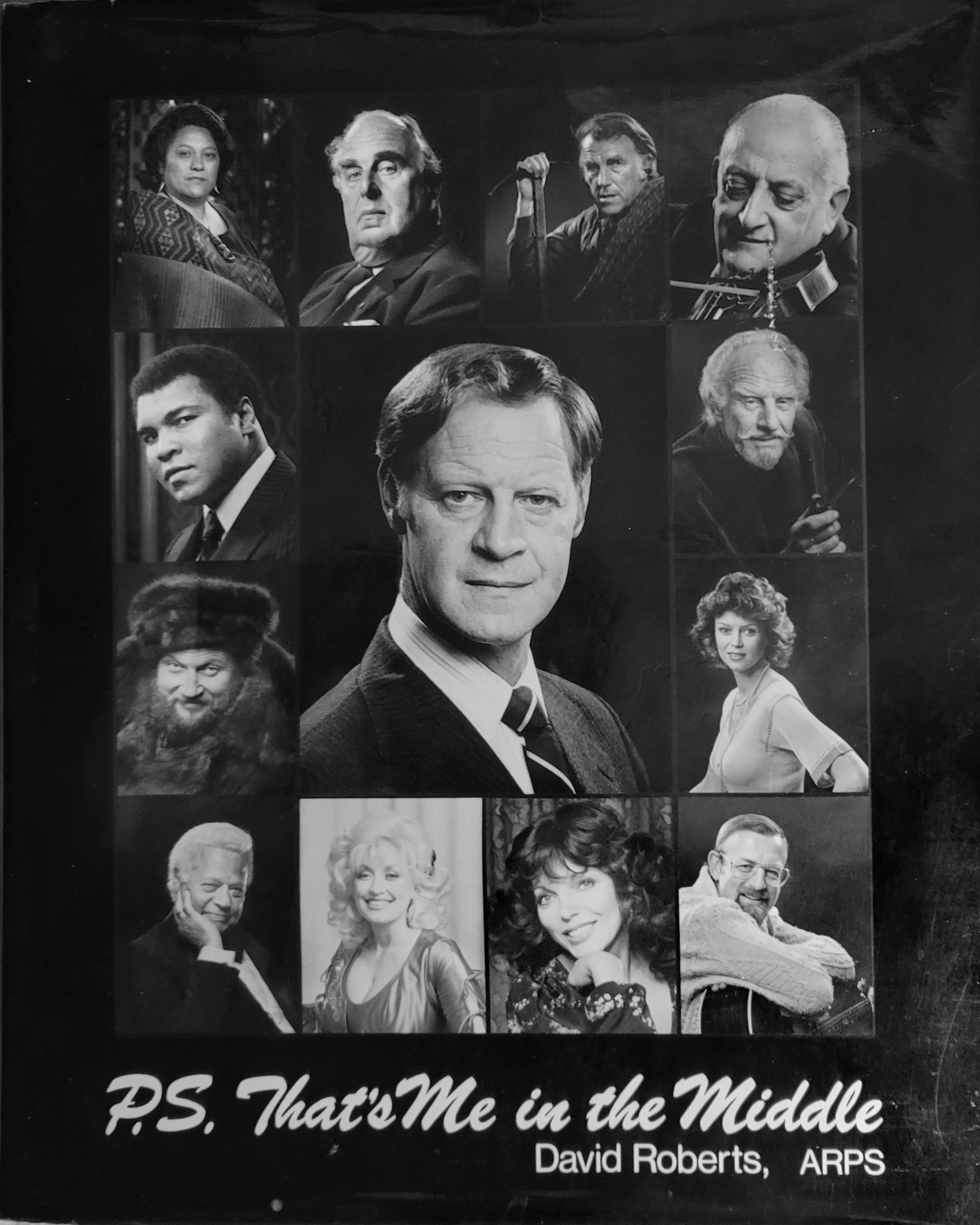
P.S. That's Me in the Middle!


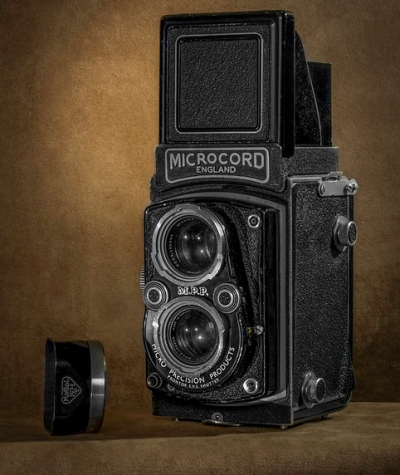 My first "real" camera was, and is, the MPP Microcord Mk II. This was made in 1958 and I bought a used model in 1960, when I served in the Bath City Police.
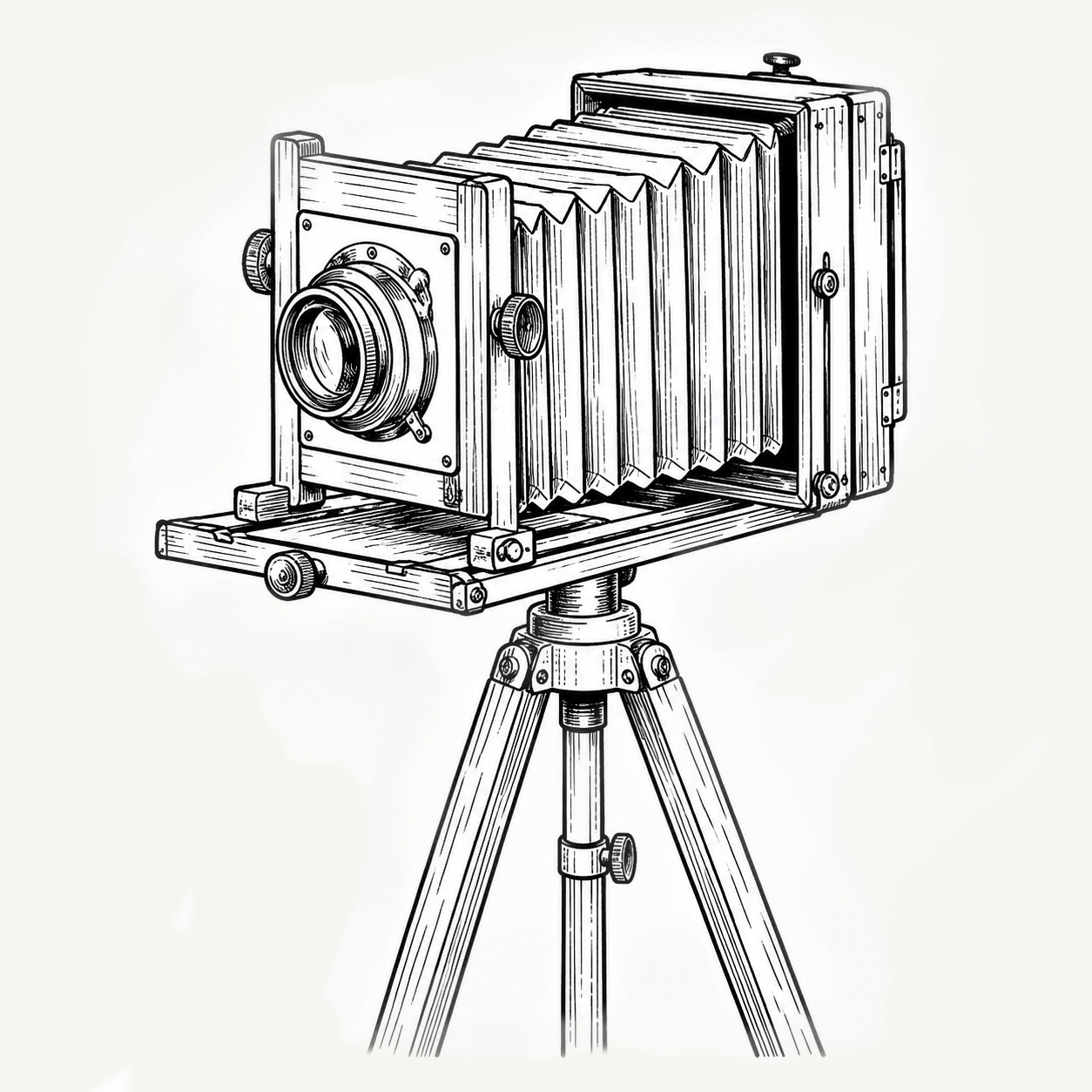
At the time, all our crime scene photography was done on a 4 x 5 Speed Graphic. I voluntarily used my camera to introduce 2 1/4" square to the force, and it later became standard.
My first "real" camera was, and is, the MPP Microcord Mk II. This was made in 1958 and I bought a used model in 1960, when I served in the Bath City Police.
At the time, all our crime scene photography was done on a 4 x 5 Speed Graphic. I voluntarily used my camera to introduce 2 1/4" square to the force, and it later became standard.